Papyrus Rylands IX

Rylands Library Papyrus P52 - recto - part of the Rylands Papyri
Rylands Library Papyrus
P52 - recto - part of
the Rylands Papyri
Papyrus Rylands IX, one of a group of nine Demotic  papyri  discovered at el-Hiba (ancient Teudjoi) on the eastern bank of the Nile River in Middle Egypt. They  are  all  concerned  with  the  affairs  of  a  priestly  family  who  lived  there  during  the  sixth  and  seventh  centuries  BCE.  The  text,  twenty-five  columns  in  length,  is  a  draft  copy  of  a  complaint addressed by one member of the family, Petiese, to the chief  finance  minister  of  Egypt  in  the  reign  of  the  Persian king Darius I,  concerning the injustices which he and his relatives suffered at the hands  of other priests in their native town.  Petiese's complaint is divided into four parts. The first narrates the  circumstances leading to its submission. In the ninth year of the reign of  Darius, a certain Ahmose came to Teudjoi  and  claimed  a  priestly  stipend, which he said was owed him. This could not be paid because the  temple finances were in such parlous condition. Seeking an explanation  for this state of affairs, Ahmose was directed to the temple scribe, who  happened  to  be  the  writer  of  the  complaint, Petiese.  As  the  latter  recounts, he blamed the temple clergy, with whom he was in dispute, for  its financial woes. These priests learned of his accusation and sought to  exact  revenge.  Lucky  to  escape  with  his  life,  Petiese fled  to  Memphis  and  asked  the  chief  finance  minister  to  take  up  his  case  and  see  that  justice was done. That official instructed him to write a full history of  his  difficulties  with  the  priests  and  how  they  arose,  and  it  is  to  this  account that the second part of the complaint is devoted.

According to Petiese, his great-great-grandfather had been inspector of a large tract of Egyptian  territory  extending  from Memphis in the  North to Aswan in the South. Finding the temple of Amun at Teudjoi  with its staff depleted, and struggling under a heavy burden of taxation,  he  arranged  for  its  taxes  to  be remitted  and restored  it  to  its  former  prosperity,  erecting  a  stela  and  two  statues of  himself  there to  commemorate his pious deed. As a reward, he was given the stipend of the prophet  of Amun of Teudjoi and  other  benefices  as  well.  Subsequently,  he  raised  a  second  stela  on  which  his  various  priestly  offices were enumerated.

The  stipends  of  Petiese's  ancestor  were  inherited  by  his  son  and  grandson.  However,  when  the  latter,  Petiese's  grandfather,  was  sent  to  accompany the king on a journey to Asia, his benefices were confiscated  by the other priests and divided among them. After his death, his son, Petiese's father, refused  to  renounce  his  claim  to  the  stipend  of  the  prophet  of  Amun  and  was  therefore forced to flee from Teudjoi with his family. In his absence, the  priests  demolished  his  house,  defaced  one  of  the  stelae  set  up  by  his  ancestor, and threw his statues into the river. Petiese, acting on behalf of  his father, was able to obtain a small financial compensation from them;  he rebuilt the house and moved the family back into it. At the time when  his petition was drawn up, however, the priestly stipend that he claimed  was still being denied him.

The  third  part  of  Petiese's  complaint  purports  to  give  copies,  in  Hieratic,  of  the  texts  on  the  two  stelae  erected  by  his  great-great- grandfather  in  the  temple  of  Teudjoi.  The  fourth  part  comprises  three  hymns  which  condemn  the  wickedness  of  evildoers  and  extol  the  righteousness of the god Amun, who avenges the ones whom they have  wronged. Plainly, Petiese's opponents are destined for divine retribution.  Papyrus Rylands IX is important for the insights that it provides into  Egyptian  economic  affairs,  social  and  political  history,  temple  administration, and legal procedure during the sixth and seventh centuries  BCE. One has to exercise caution in using it as a source of evidence, since  the  text  is  written  in  a  tendentious  manner  and  some  of  the  statements  made  in  it  are  contradicted  by  contemporary  documents.  Nevertheless,  employed with due care, it has much to offer. Regrettably, the outcome of  Petiese's complaint is unknown. The papyrus in which it is preserved is  the  latest  of  the  texts  in  the  family  archive  to  which  it  belongs.  Thereafter, the affairs of Petiese and his relatives are a closed book.

Recent Posts:


·        Ancient Egypt videos
·        Palaces in Ancient Egypt
·        Palettes in Ancient Egypt

Palettes in Ancient Egypt

Narmer Palette
Narmer Palette
Objects characteristic of early Nile cultures, palettes also appear in the Near East as imports or local imitations. Traces  of  dyes  indicate  that  they  were  used  to  grind  and  mix  mineral  pigments. Ocher, malachite, galena, pyrolusite, and hematite were  ground  and  then  mixed  with  resins,  oils,  and  fats.  The  mixtures  were used as body paints and cosmetics; powdered ocher was used  to tint ceramic vessels, and in a funeral context it was sprinkled in  grave pits or used to paint certain containers for human remains.  Typologically,  the  origin  of  palettes  is  in  Late  Paleolithic  grinders.  In  the  Early  Khartoum  period  (7400-4900  BCE),  flat  gneiss  plates  were  also  used  for  grinding  ocher.  In  the  Early  Khartoum  Neolithic  (4900-3800  BCE),  round,  oval,  and  nearly  rectangular  palettes  of  sandstone,  diorite,  and  porphyry appear in  elite burials and in settlements. Similar objects have been found in  sites of the Late Khartoum Neolithic (3800-2700 BCE).  Farther to  the north, sandstone palettes stained with ocher appear in Epipaleo- lithic cultures (e.g., Abkan, Elkabien).

Palettes  reached  their  zenith  of popularity in the Egyptian Predynastic period; they are especially common in the South, though the  oldest examples come from the North.  In  Faiyum  A, several  shapeless  or  roughly  oval  limestone  and diorite  palettes  have been found. A shield-shaped palette and several fragments in  siltstone,  basalt,  and  granite  come  from  Merimde.  El-Omari  has  provided two examples of calcite palettes, one tetragonal and one  oval. Several Upper Egyptian rhomboid or rectangular palettes of  siltstone—one ornamented with a schematic drawing that may be a  dog—are known from Maadi; tetragonal or unshaped local palettes  of  limestone  are  infrequent;  some  have  schematic  representations  of unidentifiable animals or geometric patterns.
Cosmetic palette
Cosmetic palette
By Guillaume Blanchard

Most  Upper  Egyptian  palettes  were  found  in  men's,  women's,  and children's graves, frequently near the face of the deceased. In  Southern  cultures,  the  five  oldest  examples  come  from  Tasa  (limestone or calcite [Egyptian alabaster],  in  geometric  shapes).  During  the  Badari  culture,  siltstone (earlier labeled as schist) becomes the dominant material,  and two types of palettes occur: one is rectangular, with the long  sides  straight  or  slightly  convex,  and  the  short  sides  concave  or  with  triangular  indentation;  the  other  is  oval-pointed,  sometimes  with incisions on the points.

Palettes are common in the Nubian A-Group and above all in  the Naqada culture. Typological and chronological development is  similar in both. The Naqada I phase is characterized by rhomboid  palettes.  Some  are  decorated  on  the  top  with  stylized  birds  or  horns; others are ornamented with schematically outlined, engraved  animal  figures  (e.g.,  a  crocodile  or  an  elephant),  or  with  signs  (harpoon, horns) reminiscent of the later so-called nome standards.  The  most  beautiful  is  the  Stockholm  Palette,  decorated  with  a  representation of a hippopotamus hunt:  a man in a small boat, and before him a hippopotamus, joined to  the hunter by a broken line, symbolizing the harpoon rope; behind  appear other animals (hippopotamus, two herbivores). Toward the  end of Naqada I (Phase Ic) there appear zoomorphic palettes: fish,  tortoises, and the "pelta-shaped"—in fact, a stylized representation  of  a  boat,  with  the  ends  sometimes  modeled  into  schematic  bird  heads.

During  the  Naqada  II  phase,  the  rhomboid  palettes  decrease,  though  examples  still  occur.  Shield-shaped  palettes  are  popular.  Pelta-shaped  and  zoomorphic  (fish,  tortoise,  elephant,  hippopotamus,  ram,  horned  animals)  continue  to  occur.  A  particular subgroup comprises waterfowl. Birds or bird heads often  decorate  the  tops  of  palettes,  especially  those  that  are  shield- shaped. On these, there also occur signs ("Min's emblem" on the el- Amra Palette), figures (a stylized cow's head and five stars on the  d-Gerzeh  Palette),  and  scenes.  One  of  the  oldest  (Phase  He)  decorated with a relief is the Manchester Palette, depicting a man  stalking a flock of ostriches. The identical shapes of the man's and  the birds' heads may indicate that a masked hunter is depicted, and  that the palette is associated with hunting magic.

The  period  of Naqada III  is  marked  by geometrization  of  palettes (square, rectangular, and round). The edges are frequently  decorated with a simple geometric design forming a sort of frame.  Other  shapes  are  rare.  Characteristic is  the  change  in  function of  certain  types:  the  geometrical  palettes  are  utilitarian;  the  shield- shaped  form  are  ceremonial  palettes,  and  their  decoration  is  connected with certain ideas. The latter were probably used in rites  and  rituals  involving  chiefs  and  rulers.  The  group  of  ceremonial  palettes is comprised of two basic types: one type is decorated with  zoomorphic and anthropomorphic scenes; the other is adorned onlv  with so-called heraldic and coronation animals, sculpted in tull relief. There are presently  about twenty-five such palettes and fragments known, the majority  of uncertain provenance, dated primarily to Naqada III. Some of  them  have  round  dishes  in  the  center,  invoking  the  primeval  function of the palettes, but not related to the sun cult, as has been  claimed.

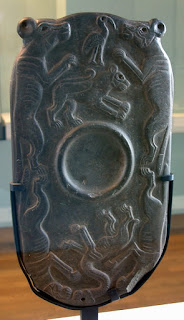
The  most  significant  in  the  first  group  is  the  Oxford  Palette,  found at the Hierakonpolis Main Deposit. It is shield-shaped; from  the  midpoints  of  the  sides,  sculpted  in  high  relief,  extend  the  figures of two wild dogs (Lycaon pictus), with their heads in full  sculpture. On the obverse appear two scenes. The upper, occupying  two-thirds  of  the  surface,  shows  two  fantastic  animals— serpopards— whose long necks surround the dish. These creatures  are  licking  a  dead  antelope,  above  which  is  a  long-necked  bird  (ostrich?). Behind the serpopards' necks and below the dish there  are three wild dogs. In the lower scene, three domesticated dogs in  collars  are  attacking  a  herd  of  herbivores,  symbolized  by  four  animals. On the reverse, the proportions are reversed: in the upper  scene (one-third of the surface), two lions attack animals identical  to the dead antelope on the obverse. The lower portion is again a  hunt: predators (a panther and a wild dog) and fantastic animals (a  serpopard and a griffin) attack a herd of herbivores. At the bottom  there is a man playing a flute (?), wearing an animal mask and a  tail on his belt, with a giraffe next to him.

The Oxford Palette is the only known example to contain such  elaborate  zoomorphic  scenes.  This  group  also  includes  objects  (e.g., the Louvre Palette) decorated with a few figures, which are  probably  an  abbreviation  (legible  to  the  ancients)  of  the  more  detailed  scenes  described.  The  animals  seen  on  these  palettes  include wild dogs, serpopards, lions, birds, oryx, and ibex. Not all  the figures are unambiguously legible to us, which results in differences  in  interpretation  and  numerous  controversies  regarding  the  symbolism and meaning of this group.

The scenes and figures described above have been interpreted  as chaotic and symbolizing "power," or as symbols associated with  life and death, peace and struggle;

the heraldic animals have been read as images of the divinities to  whom  the  palette  is  dedicated,  and  the  scenes  themselves  have  been  thought  to  be  connected  with  the  divine  myth.  Others  interpret  the  palettes  with  zoomorphic  decoration  as  the  fil-st  manifestation  of  the  cult  of  the  Divine  Eye  (the  sun),  and  the  animals  as  symbolizing  particular  mythological  figures.  A  more  likely explanation of the symbolism in this group of palettes is that  they are connected with hunting magic. The hunting theme occurs  very generally in predynastic art, initially in the same pictures as  other  subjects  (cf.  the  Hierakonpolis  painting).  Later,  perhaps  because of the limited space for decoration,  the  subjects  were  separated.  Still,  the  early  chiefs  and  rulers  were  still  the  "first  hunters"  for  their  subjects,  and  so  magical  operations were needed to aid them in performing this function and  to  ensure  success  in  the  hunt—a  success  also  enjoyed  by  other  members of society through the mediation of the king. This is also  indicated by palettes that depict domestic dogs sucking the teats of  heraldic  wild  dogs  (Metropolitan  Museum Palette,  Munagat  fragment).  The  magical  intention  was  probably  for  the  dogs  to  acquire the characteristics of wild nature. To the same categories of  hunting magic we may also assign artifacts in which the function of  the heraldic animals is served by herbivorous hunt victims (e.g., the  White Oryx Palette).

One of the more controversial motifs found on several palettes is  a palm flanked by two giraffes. Its relatively frequent occurrence  indicates that it is not coincidental. It has been regarded as a Near  Eastern motif of adoration for the holy tree; as the symbol of long  years of peace (the palm), observed by two "seers" (the giraffes); as  the  seat  of  the  sun  (the  palm),  and  the  props  of  heaven  (the  giraffes); or as a substitute for the pharaoh, similar to the srh. Since  the  motifs  in  question  also  occur  on  other  Predynastic  artifacts,  though  often  separately,  none  of  these  theories  would  seem  fully  correct.  Although  the  palm  may  be  a  symbol  associated  with  the  state and authority, it is not a substitute for the pharaoh, but rather  for  the  state,  in  both  the  territorial  and  ideological  senses;  the  giraffes may incarnate primeval forces friendly to man, symbolizing at the same time a certain part of the country.

The decoration of the Hunters' Palette (Phase IIIa/b?) stands on  the  borderline  between  zoomorphic  and  an-thropomoiphic  decoration. Its center is occupied by a representation of hunting. On  both sides appear two rows of hunters dressed in kilts, with animal  tails fastened to their belts and feathers in their long hair. Armed  with bows, lances, maces, and knives, they are hunting lions and  herbivorous animals. There is a striking lack of heraldic or fantastic  animals; yet nome standards appear in the hands of some hunters,  as  well  as  obvious  hieroglyphic  signs—thepr-mv  shrine  and  the  double protoma of a bull. This artifact, too, has been the subject of  much  controversy,  serving  for  example  as  the  foundation  for  a  theory  on  dualism  in  Egyptian  thought—an  interpretation  that  should be subjected to criticism. Probably its subject matter is hunt- ing  with  beaters,  interrupted  by  the  sudden  appearance  of  lions,  while in the hieroglyphic characters we may discern the symbol for  the king or the kingdom.

The obverse of the Battlefield Palette (Phase lllb?) is yet another  on  which  animals  have  the  dominant  role.  In  contrast  to  the  preceding example, however, the animals here are either an express  incarnation of the ruler (the lion), or they benefit from his victory: predatory birds and a canine predator  on  the  Lucerne  fragment.  People  are  depicted  here  as  defeated  naked  prisoners,  or  as  corpses  lying  on  the  battlefield.  Only  one  human  figure,  dressed  in  a  long  cloak  (preserved  fragmentarily),  clearly belongs to the victors. An important role is played here by  the nome standards (ibis, falcon), holding the captives with human  hands. Standards serve a similar function on the fragmentary Bull  Palette, perhaps the artistic masterpiece of this genre, which shows  the figure of the victor-ruler in the shape of a bull. The reverse of  the  Battlefield  Palette  is  decorated  with  the  palm-and-giraffes  motif. The fragment of the Libyan Palette is decorated on one side  with registers containing rows of bulls, asses, rams, and trees. Next  to the last is the hieroglyph 77?. On the other side, seven fortresses  are being destroyed or built by animals holding hoes in their hands.

The most  famous is the Narmer Palette, found near the Main Deposit of the Hierakonpolis  temple. On the side without a dish, under the symbols of Bat or Hathor and the royal srh,  are  two  scenes.  In  the  first,  the  king,  wearing  the  White  Crown  and  accompanied  by  a  sandal-bearer,  is  about  to  smite  a  kneeling  enemy  with  a  mace;  beside  him  is  a  pair  of  hieroglyphs  (his  name?). Facing the king is an emblematic group: a falcon with one  human arm, leading a personified land sign by a rope, and perching  on six papyrus stems that sprout from the sign. The second scene  shows two naked dead enemies and the hieroglyphic markings of  fortresses. On the other side are three registers. First, the pharaoh in  the Red Crown inspects ten beheaded prisoners;  before him are four standards and a high official (vizer, scribe, or  priest); after him, a sandal-bearer. Above the corpses is something  that is most likely the caption of a door leaf with a falcon behind it,  and  a  boat  with  a  falcon  on  a  harpoon  hovering  above.  Second,  serpopards are held in bonds by two men; the dish is framed by the  entwined necks of the animals. Third, a bull, symbolizing the pha- raoh, is destroying a fortress and trampling an enemy.

The Narmer Palette has been the object of much speculation and various, sometimes fantastic,  theories.  Among  the  most  important are those that treat it as evidence of the victory of King  Narmer  over  the  following:  the  Delta  and  the  unification of the country; the Northern rebellion, the last Lower Egyptian dynasty;  or the Canaanites. Others treat it as a year-names tablet. The theory  most nearly in accordance with the present state of research is that  the  palette  constitutes  the  ritual  confirmation  of  expansion,  was  used  in  magical  rites  preceding  further  expeditions  or  in  rituals  involving  the  ruler  during  his  coronation  or during  holidays  commemorating that event (the Appearance of the King of Upper Egypt and Lower Egypt), or for a sed jubilee.

All the palettes under discussion may have some links with the  cult and rituals surrounding the rulers of the day. We should probably agree with John Baines (1995) in asserting that  "although  the  reliefs  look  like  propaganda,  correlates  in  the  everyday world would have had to be in living ceremonial, in what  was proclaimed about the king, and in the architecture of palaces.  The  reliefs,  however,  must  be  interpreted  on  their  own  terms,  as  objects with a very small audience who were deeply involved with  their meaning and creation," and not as part of a lost repertoire.  In later periods, the function of the palette was limited to the  utilitarian.  Examples  from  the  dynastic  periods  are  rare,  and  are  typically rectangular with a trapezoidal cross section.

Recent Posts:

·        Ancient Egypt videos
·        Palaces in Ancient Egypt

Temple Palaces in Ancient Egypt

Temple of Rameses III - Medinet Habu
Temple of Rameses III -
Medinet Habu ..
By Steve F-E-Cameron
Own work, CC BY 3.0
This  distinct  type  of  palace  has  long  been  known  from Western Thebes. The best-preserved example was excavated to the south of the mortuary temple of Ramesses III at Medinet Habu. Foundations of similar buildings have been found on the southern side of  the Ramesseum and, more recently, in the southern court of the mortuary  temple of Sety I at Qurna and near that of Merenptah. These palaces were  built of mud brick against the southern sides of the temple courts, which,  as  is  typical  of  temple  components,  are  of  stone.  The  temple  palaces  exhibit  small-scale  versions  of  the  main  features  of  royal  palaces:  a  columned  reception  hall,  richly  decorated  and  painted;  a  throne  room  with two to four columns and a throne pedestal; rooms for sleeping and  rest  on  both  sides  of  the  throne  room;  and  behind  these  rooms,  small  apartments  for  attendants  (not  the  harem).  A  significant  feature  of  all  these palaces is the "Window of Appearance" in the  middle  of  the  palace  facade;  the  entrances  are  near  the  corners of the facade.

These  small  palaces  have  long  been  regarded  as  temporary  royal  residences  for  kings visiting  from their Delta  residences to participate in the Theban festivals. However, a close examination reveals that they could never have served as residences, even for a  short  stay. There  are  no  kitchens;  the bathrooms  have  no  functioning water drainage, and because the palaces are within the  sacred precincts, this sort of service utility must have been prohib- ited  on  grounds  of  ritual  purity.  Large  false  doors  carved  on  the  roof of the throne room in Medinet Habu and in the rear wall of the Quma  palace  indicate  that  these  buildings  were  intended  for  the  use of the king in the after-world. They were probably "inhabited"  by  portable  statues  of  the  deified  kings  which  appeared  in  the  "Window of Appearance" and were carried in the processions and  feasts of the necropolis.

Similar  palaces  are  attested  by  decorated  architectural  fragments that are beside other temples near important cult centers.  At Memphis a rather large  and  sumptuous  temple  palace  of  Merenptah was uncovered, part of the larger complex of temples  and  palaces  of  the  Memphite  residence.  At  Tell  el-Yehudiyya,  glazed tiles of a palace of Ramesses III were found. The powerless  kings of the twenty-first and twenty-second dynasties took over the  temple palace of Ramesses III at Medinet Habu and transformed it  into  an  official  state  palace.  They  probably  lived  in  the  eastern  High  Gate,  which  was  large  enough  for  their  modest  rituals  and  state appearances.  It was not until the twenty-sixth dynasty, under the Saite kings,  that sumptuous palaces were again built. Regrettably, the palaces  of the residence at Sais have wholly disappeared, but at Buto parts  of a large palace have recently been excavated. The best-preserved  palace  of  this  period  was  that  of  Apries  at  Memphis;  today,  however, only towering substructures and casemates bear witness  to the glorious palaces of this ancient capital.

Recent Posts:

Palaces in Ancient Egypt

From the Early Dynastic period until the late New Kingdom,  Egyptian  palaces,  temples,  and  royal  tombs  are  closely  related  through  the concepts of the divine nature of the king and the cosmological aspect  of royal dominion.

Palaces in the Early Dynastic Period:

The form of the Early Dynastic palaces of the kings of Upper Egypt, known as pr-wr ("great  house"), can be traced back to reed structures of Predynastic times. Early  in the historic period, pr-wr became the word for "sanctuary" in Upper Egypt.  A  related  term  for  "palace,"  pr-'J  (also  "great  house")  was  extended  to  the  ruler  himself  and  is  the  source  of  "pharaoh."  The  decorated high palace facade surmounted by the Horus falcon (originally  srh, "lordly exalted [building]") became the emblem of the divine ruler. The word 'h  (originally "shrine") occurs in the terms for both "royal palace" Ch-nswt)  and "palace (or fortress) of the gods" ('h-ntr). The palaces, temples, and  monumental  royal  tombs  of  the  early  dynasties  are  models  of  the  cosmos, and all are surrounded by paneled enclosure walls.

In  this  early  period,  temples  and  tombs  were  built  wholly  of  mud  brick,  with  the  exception  of  the  doorways  and  sometimes  the  floors.  Beginning in the third dynasty, tombs were built of durable stone; later,  temples too were of stone. Palaces, however, being domestic buildings  for earthly life, were constructed of brick throughout Egyptian history.

The hieroglyphic sign for 'h, based on the early structural form, looks  much like a donjon or keep, the heavily fortified inner tower of medieval  European castles, within a similarly fortified enclosure. An example of such a structure of first dynasty date is the fortress on the Elephantine Island. It  was  abandoned  and  replaced  by a more extensive  complex  to  the  west  of  the  town  which  was  dominated  by  a  small,  massive step pyramid;  this  building,  called  "The Headband of King Huni," was a kind of fortified tower which was perhaps topped by the  royal pavilion. Another early remnant has been discovered at the ancient  royal residence of Upper Egypt, Hierakonpolis:  the foundations of a richly paneled monumental gate to a royal palace or  temple.

Palaces in the Old Kingdom:

A palace of the first dynasty at Memphis is mentioned on sealings of  Adj-ib.  This  has  not  been  found,  but  the  name  of  the  early  residence  town  and  palace,  Inebu-hedj  ("White  Fortress"),  suggests  the  paneled  facades of the large first dynasty mastabas on the northern cliffs of Saqqara and the magnificent white limestone enclosure of Djoser's funerary  palace.  A  palace-like  structure  was  unearthed  by  an  expedition  of  the  German Archaeological Institute in the early dynastic layers at Tell el- Farain, or Buto, the ancient royal residence of Lower Egypt. This may  have  been  a  provincial  palace  of  the  king;  it  includes  all  the  typical  secular  elements—king's  house,  harem,  gardens  and  pools,  administrative center, armory, storehouses, and workshops.

Every  pyramid  town  had  a  palace  where  the  king  resided  while  overseeing  the  construction  of  his  pyramid  and  its  complex.  Czech  excavators  have  found  traces  of  column  bases  near  the  pyramid  of  Sahure (2458—2446)‎ (fifth  dynasty),  confirming  textual  mention  of  a  columned  entrance  hall  in  Sahure's  palace.  The  fifth dynasty  royal  architect  Senedjem-ib-Inti was praised by his king, Djedkare Izezi (2388—2356)‎, for designing  and building a large (126 X 630 meters/400 X 2,000 feet) royal palace,  "Lotus Flower of Djedkare,"  within  the  king's  pyramid  precinct  at  Saqqara South. A monumental brick wall on a solid foundation of basalt  blocks, discovered in 1994 about 1,250 meters (4,000 feet) east of the Great Pyramid, may have been the eastern enclosure of the palace or pyramid town of Khufu.

In  the  late  1990s,  a  large  palace  complex  of  about  2,500  square  meters  was  being  excavated  by  an  expedition  of  the  French  Archaeological Institute at Ain Asil in the oasis of Dakhla. It was the  residence of the Egyptian governors of the oasis. It includes residential  and administrative buildings with porticos, columned halls, warehouses,  silos, and even shrines dedicated to the memory of the governors. Parts  of a late sixth dynasty palace of a governor of the first Upper Egyptian  nome  have  been  found  at  Elephantine;  it  also  included  a  memorial  chapel to a governor, probably Hekaib.

Palaces in the Middle Kingdom:

During the Middle Kingdom, the  various  functions of the royal palace seem to separate and be relocated in more  specialized buildings. Thus, a palace of Senusret I at Thebes is named  "Senusret Is Observing the Primeval Hill," undoubtedly an indication  that  it  was  a  ritual  structure  attached  to  a  temple  that,  like  the  one  at  Medamud, incorporated a mound representing the site of first creation. The eleventh dynasty kings Inyotef and  Montuhotp may have  had  palaces  near  the  temple  of  Karnak,  at  Medamud  or  el-Tod,  or  on  the  west  bank  of  the  Nile  near  the  modern  village  of  el-Taref,  where  the  large saff-tombs of these kings were cut into the desert hillside.  From  the  thirteenth  dynasty,  we  have  an  account  book  detailing  deliveries and expenses at the palace at Thebes during visits of the royal  court over a period of several months; because this papyrus was found in  Dra Abul Naga on the western side of Thebes, the palace was probably  situated there on the hillside in front of Dra Abul Naga or Taref. The  permanent royal residence and administrative center of the twelfth and  thirteenth  dynasties,  however,  was  established  by  Amenemhat  I  at  Itjtawy near modern Lisht. Poetic descriptions of the costly decoration of  its state rooms appear in the Instructions of Amenemhat and in the Story  ofSinuhe.

Other  royal  palaces  must  have  existed  in  the  pyramid  towns  in  Dashur and the Faiyum (El-Faiyum). The acropolis of the pyramid town of El-Lahun (Kahun)‎,  the  only  such  community  of  the  Middle Kingdom to  have  been  excavated, is dominated by a large and spacious palace area and storage  areas  which  could  easily  have  accommodated  the  king's  household,  court, and administration for a long period.

An extensive Middle Kingdom palace complex has been excavated at  Bubastis, an important town and cult center of the goddess Bastet, near  modern Zagazig. In view of the extensive palace complex built earlier  by  the  governors  at  Dakhla  Oasis,  it  is  possible  that  the  Bubastis  complex was that of the governors of this rich and important province.  Statues  of  officials  found  in  one  of  its  main  rooms  suggests  that  cult  chapels for deceased governors may have existed here. However, a large  lintel and frag ments of door jambs and threshold depicting royal figures and the titulary  of Amenemhet III indicate that the palace also accommodated the king  on his visits to the temple of Bastet and the administrative center of the  eastern Delta.

Another palace, dating to the early twelfth dynasty, is found farther to the  northeast in the area of Khata'ana;  it  is  attested  by  a  monumental  gate  with  the  names  of  Amenemhet I,  renewed by Senusret III. This same region has a palace from the early  thirteenth  dynasty,  with  a  large  garden;  it  may  have  belonged  to  a  governor or even to a local ephemeral king.  Shortly after the thirteenth dynasty, the Nile Delta was taken over by  Middle  Eastern  settlers  who  proclaimed  themselves  kings.  They  were  succeeded by powerful rulers, the so-called Hyksos (fifteenth dynasty),  who established their capital at Avaris (modern Tell ed-Dab'a), with a  strongly fortified palace. This has recently been excavated by an Austrian  team.  Only  the  substructures  and  the  platform  on  which  this  mighty  palace once stood survived destruction by the Thebans, who used Avaris  as  a  staging  point  for  their  campaigns  against  the  successors  of  the  Hyksos  in  southern  Palestine.  Thousands  of  fragments  of  murals  featuring  Cretan  styles  and  motifs—probably  the  work  of  Cretan  artists—evidence  far-reaching  relations  and  cultural  interaction  at  this  period.  The  architecture  of  the palace  differs  considerably  from  any  of  previous periods: whereas the typical earlier palace covers a large area  with a series of rooms and large, columned halls without much variation  in elevation, the Hyksos palace is characterized by a high platform built  on  massive  brick  casemates  surrounded  by  columned  halls  and  monumental  staircases  leading  to  a  still  higher  platform,  on  which  the  royal apartments probably stood.

Another palace, dating to the early twelfth dynasty, is found farther to the  northeast in the area of Khata'ana;  it  is  attested  by  a  monumental  gate  with  the  names  of  Amenemhet I,  renewed by Senusret III. This same region has a palace from the early  thirteenth  dynasty,  with  a  large  garden;  it  may  have  belonged  to  a  governor or even to a local ephemeral king.  Shortly after the thirteenth dynasty, the Nile Delta was taken over by  Middle  Eastern  settlers  who  proclaimed  themselves  kings.  They  were  succeeded by powerful rulers, the so-called Hyksos (fifteenth dynasty),  who established their capital at Avaris (modern Tell ed-Dab'a), with a  strongly fortified palace. This has recently been excavated by an Austrian  team.  Only  the  substructures  and  the  platform  on  which  this  mighty  palace once stood survived destruction by the Thebans, who used Avaris  as  a  staging  point  for  their  campaigns  against  the  successors  of  the  Hyksos  in  southern  Palestine.  Thousands  of  fragments  of  murals  featuring  Cretan  styles  and  motifs—probably  the  work  of  Cretan  artists—evidence  far-reaching  relations  and  cultural  interaction  at  this  period.  The  architecture  of  the palace  differs  considerably  from  any  of  previous periods: whereas the typical earlier palace covers a large area  with a series of rooms and large, columned halls without much variation  in elevation, the Hyksos palace is characterized by a high platform built  on  massive  brick  casemates  surrounded  by  columned  halls  and  monumental  staircases  leading  to  a  still  higher  platform,  on  which  the  royal apartments probably stood.

Palaces in the New Kingdom:
Palace of Malkata (sky view)

Of the Theban royal palaces of the New Kingdom,  only  the  palace  complex  of Amenhotpe III  at  Malkata  has  yet  been  discovered.  The  rest  have  been  either  buried  under  cultivated  land  or  destroyed during later construction. Even their location is disputed. An  obvious hypothesis is that the royal palace was situated south of Karnak between the temples of Karnak and Luxor, and excavations in this area,  near the village of el-Goud, have indeed brought to light evidence of dense habitation from the  Middle Kingdom to the Late period, with town houses but no traces of a  palace. A palace on the north side of the temple of Amun at Karnak is  known  from  the  records of Hatshepsut  on  the  Red  Chapel,  but  textual  evidence from the time of Hatshepsut and Thutmose III clearly places  the  official  Theban  palace  on  the  western  side.  The  word  used  for  the  official  royal  palace  is  d^dw  ("columned  hall  of  appearance"),  a  word  that  also  appears  in  Old  Kingdom  texts.  The  designation  hft-hr-nb-s  ("Opposite  to  Its  Lord,"  i.e.,  the  temple  of  Amun)  points  to  an  area  directly across from Karnak, on the western bank, on the hillside of Dra  Abul  Naga  and  Taref.  This  is  approximately  the  same  area  where  the  palace of the early Middle Kingdom may have stood.

This  palace  was  surely  rather  moderate,  in  accordance  with  the  straitened circumstances of the early eighteenth dynasty, and could not  be compared with the large palaces of the eastern Delta. Therefore, when  Thebes under Amenhotpe III became a rich and glorious  metropolis, a  new palace city had to be created south of the city at Mal-qata. It had a  large artificial lake—the modern Birket Habu—which served as a harbor  for the royal fleet, a place  of  leisure  and  entertainment  for  the  beloved  queen,  Tiye,  and  a  stage  for  the  celebration  of  the  king's  serf-festival.  This  enormous  palace  city  (about  350,000  square  meters)  included  several  state  and  residential  palaces,  an  audience  hall,  temples  for  the  serf-festival  commemorating  the  king's  thirtieth  year  of  reign,  and  the  necessary  kitchens,  storehouses,  wine  cellars,  and  workshops,  as  well  as  administrative  buildings  and,  probably,  residences  for  the  highest  officials. The king's private apartments and the harem were probably on  terraces  on  the  hillside  above  the  artificial  lake,  affording  the  royal  family a view of western Thebes and cooling breezes. The palace area  has been only partly excavated and not well published, and, sadly, the  last  remnants  of  its  walls—painted  with  geometric  designs  and  vivid  desert hunting scenes—are eroding and falling apart.

Palaces in the Amarna period:

During  the  Amarna  period,  the  Theban  palaces  were  temporarily  abandoned,  but  they  might  still  be  used  during  royal  visits  at  the  beginning  of  the  nineteenth  dynasty.  They  must  have  fallen  into  ruin  soon thereafter, during the later years of Ramesses II, when the king no  longer  visited  Thebes.  To  provide  housing  during  visits  there,  his  successor Ramesses III enlarged his mortuary temple by the addition of two large palace buildings, the so-called High Gates. The  one  on  the  eastern  side  served  as  a  temporary  royal  residence  for  the  king, and that on the western for his harem.

Amama  Period.  Akhenaten,  the  heretic  son  of  Amenhotpe  III,  decided  in  his  fifth  year  of  reign  to  build  a  new  royal  city  on  virgin  ground  near  modem  Tell  el-Amarna,  far  from  the  old  centers  of  traditional  religion.  He  built  his  city,  called  Akhetaten  ("Horizon  of  Aten"), in great haste, and in almost equal haste it was abandoned after  his death, never to be inhabited again. Therefore, the ground plan of its  temples, palace, and residences are exceptionally well preserved. More  information about the buildings comes from the decoration of the rock- cut tombs in the ridge to the west of the city.

The  main  axis  of  Akhetaten  was  a  long,  wide  avenue  several  kilometers long—the Royal Road—flanked on both sides by temples of  Aten and palaces. The avenue began in the North City, which enclosed  the North Riverside Palace, a fortified complex with a residential palace  built on terraces on the cliffs, a large administrative building, barracks  for  the  royal  bodyguard,  and  large  warehouses  and  granaries;  in  addition, there are some large houses, perhaps the residences of courtiers  close to Akhenaten. Farther to the south lay the North Palace, another  royal  residence,  with  official  reception  halls  and  a  suite  of  courts,  gardens,  and  living  rooms  painted  with  bright  scenes  from  nature.  According  to  inscriptions  found  there,  this  was  the  palace  of  Princess  Meritaten, Akhenaten s eldest daughter and heiress, who was married to  his chosen successor, Smenkhkare.

After passing the Great Aten Temple, the avenue reached the Central  City, with the Great State Palace on the riverside and the King's House  across  the  avenue  from  it.  The  center  of  the  Great  Palace  was  an  enormous courtyard surrounded on all four sides by colossal statues of  Akhenaten, and having a suite of large halls and open courts. These were  the  state  apartments,  where  the  king  performed  the  rituals  of  royal  regeneration and received dignitaries and foreign envoys: an impressive  background  for  royal  propaganda.  At  the  southern  end  of  the  Great  Palace an extension for Smenkhkare was added at a later date, consisting  of a huge hall with 544 painted brick columns and walls encrusted with  glazed tiles. A brick bridge led across the Royal Road from the Great  Palace to a smaller palace, the King's House; this was also a building of  state, with the "Window of Appearance" where the king appeared to his  courtiers, accompanied by his family, to give daily orders and distribute  rewards. Adjacent to this palace was a personal roval chapel, the Small  Aten  Temple,  a  /;fl-house  or  mortuary  temple  of  the  king  with  roval  statues.

The  plan  of  the  palaces  and  temples  and  their  arrangement  along  a  processional  avenue  is  an  accurate  copy  of  the  grand  processional  avenues  connecting  the  temples  of  Amun  at  Thebes  in  the  time  of  Amenhotpe  III,  modified  to  the  requirements  of  Akhetaten,  where  the  various royal palaces replaced the temples and the royal family moved in  procession instead of the barks of the gods. It is therefore not surprising  that this arrangement was not repeated in the following Ramessid period.  The boy-king Tutankhamun resided in the old palace of Thutmose I at  Memphis,  and  probably  also  in  Malkata  at  Thebes.  Sety  I  began  the  construction  of  a  residential  city  and  palace  near  the  old  Hyksos  residence,  Avaris,  at  Qantir  in  the  eastern  Delta,  the  origin  of  the  Ramessid  family.  Inlays  of  faience  and  glazed  tiles  with  his  name  are  evidence for his building activities. His glorious son, Ramesses II, chose  this place for his famous residence, Piramesse. Its splendor is echoed in  glazed tiles and faience inlays from  door frames, throne pedestals, and  decorated windows—perhaps a window of appearance. Only traces of the  walls  have  yet  been  identified,  but  we  know  that  large  stables,  storehouses, and workshops for the production of weapons and faience  were  added  to  the  palace.  According  to  poetic  descriptions,  the  palace  was the center of the royal residence, with temples of the great gods lying  north,  east,  west,  and  south  of  it.  Gigantic  colossi  more  than  twenty  meters in height adorned the temple pylons facing the palace.

Piramesse  served  for  nearly  two  centuries  as  the  residence  of  the  powerful  rulers  of  the  nineteenth  and  twentieth  dynasties.  When  this  glorious city was finally abandoned at the beginning of the twenty-first  dynasty, much of its building stone was transported to the new residence  at Tanis, and the brickwork was left to decay. The palace district at Tanis  has not yet been discovered.

Recent Posts:

Pan-Grave People and Culture

The Middle Bronze Age in Nubia was roughly coeval with the Middle Kingdom and the Second  Intermediate  Period  in  Egypt  (c.2061-1569  BCE).  The  various  cultural affiliations, the developmental phases, and the sub-phases  of the Nubian peoples that lived in this era have only been broadly  defined;  they  are  still  undergoing  the  process  of  redefinition.  Of  particular interest, however, is a population belonging to the Lower  Nubian tradition—but also found in the deserts bordering the Nile River and  in  other  parts  of  Egypt—that  was  designated  by  early  archaeologists  as  the  Pan-Grave  culture.  The  name  was  derived  from  their  shallow  round  or  oval  graves  (0.5-2  meters  in  depth  [1.5-6 feet]), which resembled European baking or cooking pans.

The Pan-Grave burials can be associated with the Med-jay, the fierce Nubian bowmen mentioned  in  ancient  Egyptian  texts;  the  term is also found in the toponym Mgy, and both may derive from  the  Egyptian  term  for  "the  one  who  moves  about,"  testifying  to  their nomadism. The Medjay were attested to have been employed  as mercenaries, as an expeditionary force in Egypt, at least as early  as the Old Kingdom. They have also been associated with a group  of mercenaries resident at Gebelein during the First Intermediate Period. The fortresses built in the Second Cataract region seem, at  least  in  part,  to  have  been  needed  to  protect  the  area  from  incursions by this group. The Fort at Serra was named "repelling  the  Medjay,"  and  the  Semna  dispatches  recorded  efforts  to  keep  these peoples within their desert boundaries.

Pan-Grave People and Culture
Drawing of a stela from Gebelein
depicting a Nubian bownwn in
traditional costume with
his Egyptian wife and family.
The stela is now in the Museum
of Fine Arts, Boston
.
The confines of the Pan-Grave peoples in the desert margins has been borne out archaeologically. Cemeteries of this population  were  often  found  to  be  on  the  perimeter  of  Nubian  C-Group  or  even Egyptian cemeteries that were positioned closer to the Nile.  Whereas the Pan-Grave ceramic assemblage included incised and  black-top  pottery,  these  ceramics  differed  considerably  from  Nubian  C-Group  ceramics  made  at  that  time. For  example,  Pan- Grave black-topped "luxury wares" were very finely finished with  bodies having a distinct, level black rim; the incised wares were  often of similar exceptional quality. The Pan-Grave burial customs  and  material  culture  were  similar  to  those  of  the  Nubian  Kerma  culture  of  that  time.  The  oval  tumulus  graves  of  the  Pan-Grave  people resembled those of the Kerma culture, as did their practice  of decorating the graves with the painted skulls of horned cattle, sheep, or goats.

Daggers and axes have been frequently included in Pan-Grave burials, attesting to an owner's  possible  role  as  a  mercenary.  Distinctive Pan-Grave costume included sets of armlets or sashes  made of rectangular mother-of-pearl plaques that were bored at both ends for stringing. Other elements  of costume included beaded leather kilts, leather sandals, bead and  shell necklaces, and wire torques.

The range of the Pan-Grave people has been established as north to Middle Egypt and south to the Third Cataract of the Nile. Attestations of their presence as far south as Khartoum, however, may have resulted from some misidentification of ceramic types. As for the Pan-Grave peoples who migrated into Egyptian territory and were employed as  military guards and bowmen, Janine Bourriau (1991) has suggested that this group was acculturated  into  Egypt  throughout  the course of the Middle Kingdom. For example, a gradual evolution has been noted in some of the Pan- Grave cemeteries in Egypt, in which a segregated area with burials that follow a strictly Lower Nubian tradition give way to tombs  found within Egyptian necropoli. This evidence substantiates  Egyp-tianization. Bourriau has also suggested that the Pan-Grave mercenary soldiers  for the  Egyptian army were replaced, during  the Second  Intermediate Period, by recruits from the Kerma culture. In fact, early excavators had actually confused the Kerma burials in Egyptian cemeteries with those of the true Pan-Grave people who had also been buried there.

Recent Posts:


Ancient Egypt videos

Ancient Egyptian Monuments Part 1


Ancient Egyptian Monuments, Ancient Egypt Monuments, Ancient Egyptian, Ancient Egypt, New Kingdom, Middle Kingdom, Dynasty 18, Tuthmosis III, Hatshepsut, Amenhotep III, Ahmose I, Ramses II

Ancient Egyptian Monuments Part 2


The Secret Missions and The Great Pyramids of Egypt


The Secret Missions and The Great Pyramids, the secret chambers inside the great pyramid, the robot inside the great pyramid, ancient Egypt, the great pyramid of Giza, secrets of the great pyramid, Scan Pyramids project, The project of Pyramids Scan

Egyptian hieroglyph and Society

Egypt was the first territorial state in history, a monarchy legitimized by cosmology, founded on a society of growing complexity based in its turn on a wide reaching division of labor. This basic structure forced Egypt to develop a complex and effective administration. From Early Dynastic period until Predynastic Period, its ruling class was centered on a royal court, and civil service was its principal path to advancement and financial gains. Language constituted the adhesive force and the communicative flux of this society.

Its organization was founded on and doubly bound to theological reasoning, and much effort was spent on formulating, writing, and rewriting decorum texts, official and self fashioning verbal representations. Speaking well and well regulated eloquence were called for in councils, a prerequisite to court office and an integral part of etiquette. Independently of the individuals standing in society, it conveyed prestige and granted social acceptance. The ability to read and write was the entrance ticket to a career and to professional advancement; there were schools in the royal residence and connected to the temples, but formal education was short and followed by sometimes very long on the job training. Professional specialization was common; the administrative officials were trained mainly in Hieratic, while priests and temple officials, designers, and specific groups of artisans and workmen commanded both Hieratic and hieroglyphic scripts with varying degrees of proficiency.

In the Middle Kingdom, the growing density of educational facilities led to the emergence of literary texts designed to further social self fashioning (teachings and complaints) and to provide entertainment (fictional narratives); a selection of these texts was to become school reading in the New Kingdom. During periods of instability of the central administration (Intermediate periods) and toward the end of Egyptian civilization, literacy decreased, as did the general level of knowledge. Literacy has been calculated as I percent of the population of I to L5 million, on the basis of adult male office-holders in the Memphite necropolis of the Old Kingdom (cf. Baines I984). These figures allow for possibly higher rates in the New Kingdom, but they presumably underestimate the size of the gray area of non-professionals on the periphery of a society that rated literacy as highly as Egyptian society did.

Recent Posts:


Labels