Persian Empire

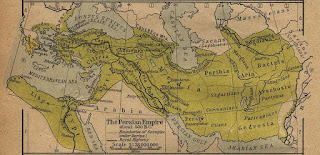
Persian Empire in the Achaemenid era, 6th century BC
In 529 BCE, the Greek general of mercenaries, Phanes of  Halicarnassus, betrayed the Egyptian pharaoh Amasis (r. 570-526  BCE). Thus the Persian king Cambyses II was able to threaten the  Egyptian  frontier.  After  Amasis  died,  his  successor,  Psamtik III,  was conquered and captured bv Cambvses in the battle of Pelusium  (525 BCE). Egypt then became, with Cyprus and Phoenicia, the sixth satrapy of  the  Achaemenid  Empire.  With  Cambyses II,  the  First  Persian  Occupation began Egypt's twenty-seventh dynasty, and it includes  Darius I (r. 521^486 BCE), Xerxes (r. 486-465 BCE), Artaxerxes I (r.  465-424 BCE), Darius II (r. 423-405 BCE), and Artaxerxes II (405- 359 BCE).  The Greek historian Herodotus traveled in Egypt about  450 BCE, so the Egypt he described was a Persian satrapy.

Memphis continued  as  the  capital  (as  it  had  been  under  the  previous Saite dynasty) and was soon the residence of the Persian  satrap, who headed Egypt's entire administration. Various officials  and  numerous  scribes  were  employed,  and  among  these  were  Egyptian  scribes  for  reports  in  their  native  language,  while  the  official language became Aramaic. The garrison posts continued to  be situated in Mareotis, Daphnis, and Elephantine, yet everywhere in the Nile Valley, between  the  Delta  and  Nubia,  there  was  a  presence  of  Near  Eastern  foreigners,  merchants,  and  soldiers— Phoenicians,  lonians,  and  Car-ians—from  all  of  the  satrapies  throughout the Achaemend Empire.

The  First  Persian  Occupation  began  with  Cambyses,  who  undertook an "Africa" policy, with three unsuccessful expeditions  against  Carthage  on  the  Mediterranean,  against  the  oasis  of  the  Libyan Desert, and against Nubia. Cambyses assumed a pharaonic  guise, as indicated by autobiographical texts of Wedjahorresenet, a  high  official  and  court  doctor.  The  texts  are  engraved  on  his  naophorus  statue  (now  in  the  Vatican  Museum),  a  basalt  statute  brought  from  Egypt  and  discovered  at  Tivoli  in  the  ruins  of  Hadrian's villa. Wedjahorresenet served under Amasis, Cambyses,  and Darius I. For Cambyses Wedjahorresenet created the epithet  mswty-R"  ("Born  of  Re"),  Cambyses  was  interested  in  removing  the  "foreigners"  (evidently  members  of  the  army  of  occupation)  from the temple of Neith at Sais, to purify the temple, to return to  the goddess her annuity, and to reestablish the priests, ceremonies,  and processions as they had been before.

Ruin and oppression certainly could have occurred throughout  Egypt during the violence of the conquest; but the evidence for the  ferocity  and  impiety  of  Cambyses  in  Egypt,  referred  to  by  the  Greek  historians,  is  not  supported  by  contemporary  Egyptian  documents.  A  stela  from the Serapeum (the  underground  catacombs  where  the Apis bulls  were  buried  at  Saqqara)  dated  from the sixth year of the Cambyses rule, testifies that Cambyses  did not kill Apis, but that instead, the sacred bull, born in Year 27  of  Amasis,  received  solemn  obsequies  and  was  buried  in  a  sarcophagus  donated  by  the  same  Cambyses,  and  that  the  succeeding  Apis,  born  during  the  reign  of  Cambyses,  died  of  natural causes in Year 4 of Darius I (as is shown by another stela  from  the  Serapeum).  To  understand  the  foundation  of  the  anti- Cambyses tradition, it is worth considering the resentment on the  part of the Egyptian priesthood, which had been stung by Cambyses' decree that  drastically  limited  royal  subsidies  to  the  Egyptian  temples  previously in effect.

Tomb of Cyrus the Great, founder of the Achaemenid Empire (the first Persian Empire) in the 6th century BC
Tomb of Cyrus the Great, founder
of the Achaemenid Empire (the
first Persian Empire) in the
6th century BC
The posthumous persecutions of Amasis by Persian conquerors  is  suggested  by  the  Cambyses  legend  related  by  the  Greek  and  Roman  historians.  In  it,  Cambyses,  a  grandson  of  Apries,  took  revenge against the usurper Amasis and reclaimed the throne of his  grandfather.  In  522  BCE,  on  the  return  trip  home  to  Persia,  Cambyses died from a leg infection incurred while in Syria. There,  in the court circle of Susa, the rebellion broke out of the sorcerer  Gaumata,  claimant  to  the  legitimate  succession  of  Cyrus.  The  circumstances  of  the  death  (a  dagger  wound  to  the  thigh  that  became gangrenous) are related by Herodotus as proof of divine  punishment—since  the  wound  was  in  the  same  spot  that  would  have  resulted  from  an  attack  on  the  Apis  bull  by  Cambyses.  According  to  Dio-dorus  Siculus,  Cambyses'  death  is  punishment  for  his  impiety.  He  is  contrasted  with  the  piety  of  his  successor  Darius  I,  who  was  generous  toward  the  temples  of  the  Egyptian  gods and revoked Cambyses' decree.

Darius  I  (522-486  BCE)  was  the  son  of  Istaspe,  satrap  of  Hyrcania;  Darius  was  a  tolerant  and  strong  ruler  who  restored  order  in  the  empire  and  conquered  a  new  province,  India.  According to Diodorus, Darius I was the sixth and last law-giver  of Egypt, as confirmed by the Demotic papyrus mentioned above.  In  his  third  year  of  rule,  Darius  ordered  his  satrap  in  Egypt  to  convene the learned among the soldiers, the priests, and the scribes  so as to codify the laws in use to Year 44 of the reign of Amasis.  His  committee  of  wise  men  sat  for  sixteen  years,  until  Darius's  nineteenth year. Between his nineteenth and twenty-seventh year,  the committee was reunited at Susa and the laws were transcribed  on  papyrus  in  Aramaic  and  Demotic.  Such  a  juridical  guide  for  Egypt was needed by the administration of that satrapy, since they  were generally Persian or Babylonian and their official language  was Aramaic.

The  protection  accorded  to  Egyptian  temples  and  priests  by  Darius  I  was  extended  to  the  construction  of  a  grand  temple  to  Amun-Re, in the Kharga Oasis (an archive of Persian-era Demotic  ostraca  was  recently  found at Deir  Manawir). Darius  Is  building  activities  in  Egypt  are  also  known  from  the  hieroglyphic  inscriptions in the quarries of Wadi Hammamat, from blocks with  Darius' cartouche found at Elkab, and from those at Busiris in the  Delta. A large number of the Saqqara Serapeum stelae have dates  between  the  third  and  fourteenth  year  of  Darius I.  A  small  stela  from  the  Faiyum (now  in  the  Berlin  Museum)  is  dedicated  to  Darius I  in  the  form  of  the  falcon-god  HOI-US.  The  Vatican  naophorus  statue  of  Wed-jahon'esnet  reveals  that  Darius  ordered  restoration work at the "House of Life" at Sais.

Yet rebellion against the Persians was constant. Aryandes,  the  first  satrap  of  Egypt,  was  deposed  by  Darius  I  after  rebelling. Pherendates succeeded him in 492 BCE and was the satrap  to whom Peteese of Teudjoi referred his petition in Year 9 of Darius  I,  to  obtain  justice  (Demotic  Papyrus  Rylands  IX).  To  intensify  contact  with  the  Egyptian  satrapy,  Darius  I  accomplished  an  objective imagined but never carried out by Necho II—the opening  of  a  navigable  route  from  the  Nile  to  the  Red  Sea.  This  was  accomplished  by  means  of  a  canal  45  meters  wide  and  5  meters  deep (130 by 15 feet) that could be traveled for some 84 kilometers  (52  miles),  enabling  navigation  from  Bubastis  at  Lake  Timsah  by  the Bitter Lakes (Gulf of Heroonpolita) to the Red Sea in four days.  Along the route of the canal were erected commemorative stelae of  large dimensions—over 3 meters (10 feet) in height and 2 meters (6  feet)  in  width—in  the  three  languages  of  the  empire:  Elamite,  Akkadian, and Old Persian; they were located at Suez, at Chaluf or  Kebret,  at  the  Serapeum,  and  at  Pithom  (Tell  el-Maskhuta).  The  waterway, which tended to silt up in the southern part, was put back  into  use  under  Ptolemy  II  (according  to  the  stela  discovered  at  Pithom) and also under the Roman emperor Hadrian. From as early  as Cambyses, the Persian kings resorted to Egyptian sculptors and  stonemasons,  who  are  often  mentioned  on  the  Elamite  foundation  tablets  of  Persepolis.  Many  learned  Egyptians,  especially  doctors,  resided at the Court of Susa.

Trade  with  Persia  was  important  to  Egypt.  An  Aramaic  text,  recovered  by  B.  Porten  and  A.  Yardeni,  contains  the  accounts  of  many  colonies  and  of  maritime  traffic  for  a  port  (probably  Memphis) during Year 11 of Xerxes I (475 BCE). The captains of the  ships—which  brought  gold,  silver,  wine,  oil,  and  lumber—are  indicated  as  lonians  and  have  Greek  names  (e.g.,  Simonides,  Moskhos, Tymok-ledes, Mikkos, lokles, Phanes', etc.); other ships'  captains  are  perhaps  Phoenician.  The  boats  returned  loaded  with  Egyptian natron (sodium carbonate), highly valued in antiquity for  the manufacture of glass.

From  404  to  343  BCE,  the  recovered  independence  of  Egypt  included  the  twenty-eighth,  twenty-ninth,  and  thirtieth  dynasties.  The  rulers  of  the  thirtieth  dynasty  defended  Egypt  from  Persia's  attempts at reconquest, even resorting to alliances with the Greeks.  Nektanebo I secured the support of the priesthood by a maneuver  that  consisted  of  a  customs  tax  on  merchandise  that  arrived  at  Naukratis in the Nile Delta (the Greek emporium from the time of  the  Saite  kings),  allotting  10  percent  of  the  tax  to  the  temple  of  Neith  at  Sais.  Nektanebo's  son  Tachos  (or  Teos;  r.  362-360  BCE)  intervened militarily in an anti-Persian role in Syria, but his uncle,  the  general  Tjaha-pimu,  who  was  kept  in  Egypt  as  regent,  took  advantage  by  placing  his  own  son,  Nektanebo,  by  the  Queen  Udjashu,  on  the  throne.  This  change  was  favored  because  of  the  discord incurred by the financial measures that Tachos took.  He  limited  the  priests'  revenues  and  a  tax  was  imposed  on  housing and on the grain to be offered to Atria, in addition to the  tenth  due  on  ships  and  crafts.  Tachos,  betrayed  by  the  Spartan  general Agesilaos, fled Egypt, took refuge at Sidon, and then at the  Persian court at Susa.

Nektanebo  II  (r.  361/60-343  BCE)  repelled  two  Persian  invasions: one in 358 BCE, by the army of Prince Arta-xerxes; the  second  in  351  BCE,  led  by  the  same  man,  now  Ar-taxerxes  III  Ochus. When he retook Cyprus and Sidon, he was able to land at  Pelusium in the Nile Delta. From Pelu-sium, the Persians then took  the  other  cities  of  the  Delta  and  as  far  south  as  Memphis.  Nektanebo II escaped to Nubia with his treasure. Classical sources  accuse Artaxerxes III of violence and brutality even more subtle  than  that  ascribed  to  Cambyses.  Then  in  338  BCE,  the  eunuch  Bagoas murdered Artaxerxes; in 336 BCE, he also killed the king's  son  and  successor  Xerxes.  Under  Darius  III,  the  satrap  Sabace  fought  and  died  at  Issus.  The  last  Persian  satrap,  Mazaces,  lost  Egypt  to  Alexander  the  Great  of  Macedon  in  332  BCE.  The  Achaemenid Empire had ended, and Egypt had become a province  once more. After Alexander, the Ptolemies and then the Romans  became  the  masters  of  the  Nile  Valley,  which  was  governed  by  foreign rulers until after World War II.

Recent Pages:


·        Lake Mariotis in Ancient Egypt
·        Egyptian hieroglyph and Society
·        Ancient Egypt videos
·        Pan-Grave People and Culture
·        Pepinakht Heqaib
·        Personal Hygiene in Ancient Egypt
·        Perfumes and Unguents in Ancient Egypt

Perfumes and Unguents in Ancient Egypt

In  modern  parlance,  a  "perfume"  is  made of essential oils in an alcohol base. Distillation of pure alcohol  was unknown in pharaonic times;

"perfume"  or  "cologne"  as  such  did  not  exist  in ancient Egypt.  Instead, oils and fats were impregnated with the essences of various  plants.  It  is  almost  impossible  to  tell  from  what  substances  these  extracts  were  made,  since  the  essential  oils  have  not  survived  in  extant  samples  of  unguents.  Scholars  can  only  reconstruct  the  ingredients from images in tombs, recipes for scent from the Greco-Roman period,  and  knowledge  of  the  raw  materials  available  to  pharaonic perfumers.
The  plants  used  to  scent  pharaonic  perfumed  oils  most  likely  included the water lily (lotus) and the flowers of the henna plant. Two varieties of water lily, (Nymphaea caeru-lea and  N.  lotus),  are  denoted  (inaccurately)  by  Egyptologists with  the  single term "lotus." Nymphaea was a supremely important plant for  the  ancient  Egyptians,  used  as  decorative  element,  food,  and  medicine,  and  replete  with  religious  symbolism.  Its  scent  was  supposedly that of the sweat of the gods; its opening and closing  mimicked the pattern of life and rebirth. It has been suggested that  plant's essence, dissolved in wine, was used as an intoxicant.

Egyptian scene depicting the preparation of lily perfume, 4th century BC
Egyptian scene depicting the
preparation of lily perfume,
4th century BC
The flowers of the henna plant (Lawsonia inennis) also have a  strong scent, which would have been used in perfumes, as might  other fragrant flowers such as the Madonna lily (Lilium candidum).  Representations  of  perfume-making  from  the  Late  period  show  a  plant  resembling  the  Madonna  lily  being  picked  and  pressed  to  extract its essence.

Other scented substances—cedar wood, cinnamon bark, resins,  herbs (such as thyme), and spices (such as coriander)—would have  been used in the creation of unguents and perfumes. The resins in  use no doubt included myrrh and frankincense, as well as ladanum  or galbanum. Ladanum is derived from the leaves and branches of shrubs of the genus Cistus, which grow in many locations around  the Mediterranean. Galbanum, derived from Ferula (a large herb),  would have been imported from Persia, possibly by the time of the  New Kingdom.

Both the leaves and the bark of the various types of cinnamon  tree  (Cinnamomum  zeylanicum,  C.  camphora,  or  C.  cassia)  may  have  been  utilized  in  the  preparation  of  unguents  and  perfumes,  certainly by the Roman period, as the use of the term kinamomon in  Coptic attests. During the Roman Empire, an extremely expensive  scent called malabathron, made with cinnamon, was highly prized.  The type of cinnamon bark used was probably C. wylanicum, which  is not native to Egypt but to Ceylon.

Perfume  could  be  created  by  crushing  the  aromatic  elements  (seeds, bark, flowers, leaves, and so on) and infusing oil or fat with  them.  Three  techniques  seem  to  have  been  in  use:  enfleurage,  in  which layers of fat are saturated with perfume from flowers, which  would be replaced from time to time; maceration, in which flowers  or  other  plant  materials  are  dipped  into  fats  or  oils  heated  to  a  temperature of about 65°C, and the mixture then sieved and allowed  to cool; and expressing the perfume directly from flowers or fruit.  Many types of oils derived from nuts and  seeds  were  available  for  use  as  the  base  of  perfumes  and  unguents, including baianos oil, linseed oil, olive oil, sesame oil,  almond oil, and ben oil. Ben oil was derived from the horseradish  tree (Moringa oleifera). Castor oil would also have been available,  but as it has a strong smell, is unlikely to have been used. Olive oil  and almond oil would have been among the most expensive since,  although they can grow in Egypt, these trees were not native to the Nile Valley and would have required special cultivation. Almond  oil  has  a  particularly  sweet  smell  which  would  have  made  it  desirable as a base for scent or makeup.

With all of these varying types of vegetable oils available, it is  interesting to note that of the thirty-five vases of perfumes found in the tomb of Tutankhamun, the only one that had not been emptied was  found to contain an unguent based on animal grease. The animal  from which the fat came has not been determined. In medical texts  from  ancient  Egypt,  however,  the  fat  of  geese  and  the  tallow  of  oxen  are  most  often  specified  as  a  base  for  remedies  applied  externally. The fat of ducks, sheep, and goats, less expensive and  thus  more  widely  available,  might  also  have  been  used.  In  one  analyzed  specimen  of  unguent,  the  fatty  matter  was  mixed  with  another substance, which was tentatively identified as a balsam or  resin  (such  as  myrrh).  This  might  have  been  included  to  add  fragrance  or  to  fix  the  scent  already  mixed.  A  few  containers  of  perfumes from the tomb contained only resin, a Middle Kingdom  sample  also  contained  tiny  splinters  of  wood.  The  latter  were  almost certainly from a fragrant tree such as cedar.

The sophistication of pharaonic perfumers in creating fragrances  should not be underestimated. Both Pliny the Elder and Athenaeus,  in  fact,  claim  that  Egyptian  fragrance  was  the  best  in  the  world,  because its scents were the longest lasting and it was the country  best suited to the production of perfume (presumably owing to the  great number of ingredients available there). A number of ancient  authors,  such  as  Pliny,  Dioscorides,  and  Theophrastus,  give  recipes  for  perfumes  which  include  several  ingredients.  For  example,  a  famous  perfume  from  Mendes,  one  of  several  mentioned  by  classical  authors,  contained  ba-lanos  oil,  cassia,  myrrh,  and  aromatic  resins.  In  his  book  Concerning  Odours,  Theophrastus  mentions  a  scent  made  from  cinnamon  and  myrrh  mixed with other, unnamed substances.

One  item  of  pharaonic  perfumery  that  has  created  discussion  among  scholars  is  the  cones  which  appear  on  the  heads  of  banqueters  and  others  in  festive  garb  during  the  New Kingdom.  These cones are usually believed to have been made of scented fat,  probably  ox  tallow  impregnated  with  myrrh,  although  there  has  been  a  recent  suggestion  that  they  were  made  of  beeswax.  Egyptologists have noted that a similar custom survived among certain Bedouin tribes until  the present century, and fat was worn as a hairdressing by Nubian  tribes.  Egyptologist  Rita  Freed  has  suggested  that  the  custom  originated as a means of counteracting the drying effect of the sun  on hair.  Many  unguents  and  oils  were  made  from  expensive  or  rare  substances.  Thus,  in  ancient  Egypt  most  unguents  and  perfumes  would have been easily available only to the rich. The importance  of  scent  to  personal  hygiene  and  wellbeing,  however,  was  universal. Unguents and scented oils were an essential part of the  daily  toilette  for  all  classes  throughout  Egyptian  histoi-y  because  oils and unguents were essential to protect and condition the skin in  the  dry  climate.  In  fact,  the  striking  workmen of Deir el-Medina listed body oil as one of their demands. Both sexes were advised to  rub  pellets  of  ground  carob  (or  juniper)  into  the  skin  to  act  as  a  deodorant.

Recent Pages:


·        Lake Moeris (Lake Karun)
·        Wadi Natrun in Ancient Egypt
·        The Western Desert in Ancient Egypt
·        Lake Mariotis in Ancient Egypt
·        Egyptian hieroglyph and Society
·        Ancient Egypt videos
·        Pan-Grave People and Culture
·        Pepinakht Heqaib
·        Personal Hygiene in Ancient Egypt

Personal Hygiene in Ancient Egypt

The most important element of personal hygiene was always cleanliness, achieved by frequent washing or  bathing. Priests had to wash daily, or more often, to remain ritually  pure. Upper-class houses of the New Kingdom were equipped with  bathrooms, usually consisting of a room or alcove equipped with a  stone slab on which people might kneel or stand while water was  poured over them from above.

Soap, as it is known today, did not exist. Modern soap is made of  fat and lye obtained by pouring water over hardwood ash. Given the  lack of hardwood trees in Egypt and surrounding countries, ancient  inhabitants  of the Nile Valley had to  find  other  cleansers.  Thus,  instead  of  soap,  ancient  Egyptians  compounded  "body  scrubs"  of  salt,  natron,  and  honey  to  cleanse  the  body.  Recipes  for  these  cleansers are found in medical papyri. One such cleanser, from the  back  of  the  Edwin  Smith  Medical  Papyrus,  also  includes  calcite  (Egyptian alabaster)  granules.  In  the  burial  effects  of  the  minor  wives  of King Tuthmosis III (1504-1450),  pots  of  "cleansing  cream,"  consisting  of  vegetable  oils  or  animal  fat  and  lime  (CaO),  were  found.  Natron could also be used alone as a cleanser. (Although natron was used in  mummification,  its  use  as  a  skin  cleanser  is  not  as  unlikely  as  it  might seem: some modern bath cubes consist of talc, scent, calcium  carbonate,  and  calcium  bicarbonate,  the  latter  two  being  the  chief  components of natron.) After cleansing, the skin would need to be  moisturized with unguents and scented oils to keep it from drying  out in Egypt's arid climate.

Recent Pages:


·        The Western Desert in Ancient Egypt
·        Lake Mariotis in Ancient Egypt
·        Egyptian hieroglyph and Society
·        Ancient Egypt videos
·        Pan-Grave People and Culture
·        Pepinakht Heqaib

Pepinakht Heqaib

Entrance of the tomb of Heqaib at Qubbet el-Hawa
Pepinakht Heqaib, whose  "good  (or  familiar)  name"  was  Heqaib ("ruler of my heart"), was a major official at Elephantine island , an  island in the Nile River near Aswan, during the reign of King Pepy II (2278-2184). His  principal  title  was  "Overseer  of  Foreigners"  (i.e.,  mercenaries).  A  rather bellicose "autobiographical" inscription in his tomb at Qubbet el-Hawa  (Aswan)  indicates  that  he  was  primarily  responsible  for  controlling the military situation in Nubia and the Eastern Desert at  a  time  when  the  attacks—presumably  by  the  new  C-Group  population—on  Egyptian  expeditions  to  the  south  and  east  were  increasing.  The  king  dispatched  him  to  devastate  ("hack  up")  the  Lower Nubian districts of Wawat and Irtjet, and Pepinakht reports  killing  numbers  of  Nubians  and  bringing  back  some  unspecified  number  of  captives,  along  with  their  cattle  as  booty.  On  another  campaign,  he  claims  to  have  brought  back  the  chiefs  of  these  districts,  their  children,  and  members  of  their  entourages.  Subsequently, Pepinakht was sent to the Red Sea coast to recover  the bodies of an expedition leader named Ankhty and his men, who,  while  building  a  boat  there  for  a  trip  to  the  land  of  Punt  (on  the  Somali coast), had been murdered by the locals. Pepinakht drove off  the tribesmen, trumpeting that he had "set the fear of Horus [i.e., the  king] in the foreign countries," thereby pacifying them. In addition  to  his  military  activities,  Pepinakht Heqaib  performed  administrative  functions  in  the  pyramid  complexes  of  both  King Merenre and King Pepy II.

Pepinakht Heqaib  appears  to  have  enjoyed  a  considerable  reputation in the Aswan region, for at some time after his death, he  was deified and became the object of a cult among the officials at  Elephantine  that  lasted  until  the  Middle Kingdom.  Excavations  carried  out  principally  by  Labib  Habachi  and  inscriptions  in  the  tombs  of  later  officials  indicate  that  a  series  of  shrines,  complete  with  altars  and  statues,  had  been  built  on  Elephantine  Island  in  Heqaib's honor.

Recent Pages:


·        Lake Moeris (Lake Karun)
·        Wadi Natrun in Ancient Egypt
·        The Western Desert in Ancient Egypt
·        Lake Mariotis in Ancient Egypt
·        Egyptian hieroglyph and Society
·        Ancient Egypt videos
·        Pan-Grave People and Culture

Transporting Stone and Metal in Ancient Egypt

A number of variations of the Old Kingdom titles "Master of the Roads" and "Official of the Masters of the  Roads"  have  been  found  both  in  the  Memphite necropolis  and  in  the  mining areas of the Wadi Hammamat and Wadi Abbad (in the Eastern Desert), suggesting that the coordination and maintenance of land routes  through the desert was a high priority for the Egyptian administration.  Many  archaeological  traces  of  specially  constructed  roads  have  been  found in the areas surrounding mines, quarries, and major structures.
Drawing of the transportion scene of the colossu
In the case of mineral resources exploited regularly for long periods,  considerable amounts of time and energy were spent on the building of  roads,  the  nature  of  each  route  being  determined  primarily  by  such  factors as the bulk and quantities of the minerals, the nature of the topography, and the materials locally available for road-building. Thus the  Old Kingdom quarries at Hatnub are linked with the Nile Valley by a drystone  causeway  extending  for  some  17  kilometers  (11  miles),  two  small  stretches  of  which  are  built  up  to  a  height  of  several  meters,  to  allow  stone  blocks  to  be  dragged  across  deep  wadis.  A paved  road  employing  slabs  of  sandstone  and  fossil  (petrified)  wood  conects  the  Gebel  Qatrani basalt quarries with  the  site  of  Qasr  el-Sagha  at  the  northern end of  the Faiyum region, covering a distance of  about  10  kilometers  (6  miles).

The longest known Egyptian quarry road is an 80-kilometer (50-mile)  route in Lower Nubia, linking the diorite-gabbro and anorthosite gneiss  quarries of the Old and Middle Kingdoms, near Gebel el-Asr, with the  closest Nile embarkation  point  (at  the  former  Tushka,  now  because  of  the  new  Aswan  High  Dam,  covered  by  Lake  Nasser).  In  the  1930s,  Reginald  Engelbach  undertook  a  detailed  examination  of  the  ancient  road, which was not a built structure (like the roads to Hatnub and Gebel  Qatrani) but instead appears to have been simply a cleared track through  the desert, with occasional scatters of stone or pottery.  An  important  indication  of  the  degree  to  which  ancient  Egyptians  planned  and  organized  their  quarrying  and  mining  expeditions  has  survived in the form of the Turin Mining Papyrus. This document—the  earliest surviving Egyptian map—is an annotated record of an expedition  to the mines and quarries of the Wadi Hammamat in the Eastern Desert  in the mid-twelfth century BCE. The area depicted in the map has been  identified with the archaeological site at Bir Umm Fawakhir, where there  are still extensive remains of a Byzantine gold-mining settlement.

Recent Pages:


People of Ancient Egypt

Tracking the movements and establishing the identity of  peoples in the archaeological and historical records is a difficult and often ambiguous project. Physical  anthropology  is  the  best  source of identification, but the early misuse of the "race concept"  created  overly  simplistic  definitions  driven  more  by colonialism  and  racism  than  by  science.  Modern  studies  based  on  population  genetics are much more complex and yield more ambiguous results.  Historical  linguistic  evidence,  especially  names,  is  also  used to establish group identities where historical records exist, as is often the case in Egypt and the surrounding  regions.  Archaeological data  have  been used  to  reconstruct the  identity of  ethnic groups in two ways; by characterizing artifact assemblages  as culture areas, without necessarily establishing that they belong to  a historically known group; and by matching groups identified in  texts with an artifact assemblage. Unlike physical anthropology and  linguistics, archaeological evidence is abundant and relatively easy  to  analyze,  but  all  studies  of  this  kind  rest  on  the  important  assumption that a given artifact assemblage does in fact represent a  cultural identity, rather than a sphere of cultural influence or culture  contact—and this may or may not be true. Radical diffusionists in  the  late  nineteenth  and  early  twentieth  centuries  favored  massive  movements of peoples as the engine of cultural change. Thus W.  M.  Flinders  Petrie's  "Dynastic Race"  concept  linked  cultural  achievement  with  racial  identity  in  the  origins  of  pharaonic  civilization.  These  models  have,  unfortunately,  been  revived  by  some  Afro-centric  scholars,  who  otherwise  rightly  emphasize  Egypt's  African origins.  Diffusion  and  population  movements  did  exist  in  the  past,  but  they  must  be  carefully  demonstrated.  For  example,  the  identity  of  Uruk  colonies  (c.3500  BCE)  in  southern  Anatolia  was  established  by  using  a  combination  of  architecture,  material  culture,  and  textual  evidence.  In  a  similar  way,  a  combination of archaeology, text, and art history has documented  an  Egyptian  colonial  presence  and  the  diffusion  (and  subsequent  adaptation)  of  certain  aspects  of  Egyptian  iconography,  ideology,  and institutions in Nubia and in Syria-Palestine.

Recent Pages:


Quartzite in Ancient Egypt

Quartzite, the hardest and toughest stone normally encountered in  nature  (7  on  Mohs  Scale  of  Hardness).  The Egyptian variety  is  a  sedimentary stone, correctly termed an "orthoquartzite" (to distinguish it  from  the  metamorphic  quartzites).  Quartzite  is  composed  of  quartz  (a  crystalline form of silica) grains solidly cemented with chemical silica— so  the  cement  and  the  grains  are  of  the  same  material.  Silica  cement  interlocks  the  grains  and  fills  in  the  pore  spaces,  making  a  dense,  compact stone of great strength.

Egyptian  quartzite  quarries  are  located  at  Gebel  Ahmar  near  Cairo,  at  Gebel Gulab, and at Gebel Tingar near Aswan (within  the  Oligocene  Gebel  Ahmar  Formation).  Other  sites  occur  within  silicified  Upper Cretaceous  Nubia  Group  sandstones  (the  Umm  Barmil  Formation).  Egyptian quartzite  is  usually  white,  with  reddish, yellow, and orange varieties, the colors being produced by iron  oxides. It was often used for sarcophagi, statues, and portcullis stones.  Quartzite behaves much like large quartz masses (also 7 on Mohs Scale  of  Hardness)  and  can  be  worked  with  little  concern  for  breakage  or  cleavage—but it was not ordinarily used as an architectural stone. None- theless,  some  examples  include  pillars  in  Pepy  Us  pyramid  court  at  Saqqara; the burial chamber of Amenemhat III (1844-1797) at Hawara; the Tuthmosis III (1504-1450) Chapelle Rouge blocks at Luxor; and included here for their immense  size, the so-called Colossi of Memnon at Luxor. These colossal statues  were sculpted from single quartzite blocks of 21.3 meters (64 feet). Since  quartzite  occurs  mainly  in  Lower  Egypt,  the  transport  of  such  large  stones upriver must have been a serious consideration.

For sculpture, quartzite takes a fine polish and the colors can be used  for  pleasing  effects.  Examples  include  the  head  of  Nefertiti and  the  wonderful  figures  of King Amenhotep III (1382-1344). Betsy Bryan  (Kozloff  and  Bryan  1992) states that quartzite was chosen as "an indicator of the solar devo- tion, for red, yellow, and gold tones were considered the sun colors."  Quartzite  was  far  harder  than  the  metal  tools  (copper,  bronze)  available, so it must have been worked with tools fabricated from other  forms  of  quartz—chert  (flint)—as  well  as  quartz  fragments.  The  final  finishing  would  have  been  done  by  polishing  with  rubbing  blocks  and  quartz sand. This extreme hardness may have made quartzite a "status"  stone for statuary.  Quartzite was known to ancient Egyptians as nmti, nmtt, biJyt, biyt,  inr-n-dw, mr-n-bnwt, mr-nfr-n -biyt-'yt, inr-n-rwdt nt-dw-dsr, and mr-n- bnwt.

Recent Pages:


Quarrying Tools in Ancient Egypt

The types of tools used for the quarrying of  soft  stones  (Mohs  1-5)  during  pharaonic times  has  not  been  definitively  determined.  Judging  from  the  marks  preserved  on  quarry walls, some type of axe or pointed pick was probably used  in  the Old and Middle Kingdoms, whereas  a  pointed  chisel  hammered  with  mallet  was  evidently  employed  from  the  New Kingdom onward. The wide grooves on the surfaces of a few stone  blocks suggest that a very large stone chisel may sometimes have  been used. Some Egyptologists have argued that most of the tool  marks  were  made  by  soft  copper  chisels  in  the  Old  and  Middle  Kingdoms  and  harder  copper  or  bronze  chisels  from  the  New  Kingdom  onward  (with  characteristic  patterns  possibly  deriving  from specific chronological phases); others have pointed out that  harder  alloys  would  already  have  been  available  during  the  Old  Kingdom. Those chisels that have survived at ancient construction  sites  usually  have  a  broad,  flat  cutting  edge  rather  than  a  point.  Chert and flint (Mohs 7) tools were also used for stoneworkine.

As far as the extraction of such hard stones as granite (Mohs 6-7) is  concerned, it was once assumed—because of the many surviving groups  of  rectangular  wedge  holes  at  Aswan—that  the  rock  was  removed  by  inserting wet wooden wedges into holes and levering the blocks away  from the bedrock. It has been pointed out, however, that even wooden  wedges soaked in water would generally not have been strong enough to  break the granite, and that no wedge holes have yet been securely dated  to pharaonic times. Iron wedges could have been used to extract hard  stones from the Ptolemaic period onward. Various experimental studies  and analyses of the quarries at Aswan suggest that the actual process of  extraction  in  pharaonic  times  involved  the  excavation  of  opencast  quarries,  by  means  of  hammerstones,  gradually  removing  the  desired  stone from the surface downward. In the quartzite quarry at Gebel Gulab  (on  the  western  bank  at  Aswan),  a  broken  obelisk  inscribed  with  the  name of the nineteenth dynasty ruler Sety I survives  in  situ  near  the  quarry face from which it was extracted. The nearby quarry face shows  definite traces of the use of stone pounders. Pounder marks have also  been found at Qau el-Kebir, in a limestone quarry of unusually dense  and hard rock (limestone may be soft [Mohs 3], medium [Mohs 4], or  dense and hard [Mohs 5]). Further evidence for the extraction of stone  by pounding has survived in the form of a set of marks in the siltstone  quarry  of  the  Wadi Hammamat, which  may  well  date  to  pharaonic  times.

Recent Pages:


Origins of the Egyptians in Northeastern Africa

In spite of  the  evidence  against  scientific  race,  both Egyptologists and  Afrocentric  scholars  often  continue  attempts  to  define  the  Egyptians  as  members  of  an  essentialist  racial  category,  usually  attempting to link them either to a supposed  "Caucasoid"  or  "Negroid/Africoid"  phenotype.  Such  models  imply  that  the  founders  of  pharaonic  Egypt  came  from  sub-Saharan  Africa,  western  Asia,  or  Europe/Trans-caucasus.  While there was some immigration from all these areas, physical  anthropology  has  demonstrated  the  fundamental  continuity  of  ancient  and  modern Egyptian populations.  The  evidence  also  points  to  linkages  to  other  northeastern  African  peoples,  not  coincidentally  approximating  the  modern  range  of  languages  closely  related  to  Egyptian  in  the  Afro-Asiatic  group  (formerly  called Hamito-Semitic). These linguistic similarities place ancient  Egyptian  in a  close  relationship  with  languages  spoken  today  in  northeastern  Africa  as  far  west  as  Chad  and  south  to  Somalia.  Archaeological evidence also strongly supports an African origin.  A widespread northeastern African cultural assemblage, including  distinctive  multiple  barbed  harpoons  and  pottery  decorated  with  dotted wavy line patterns, appears during the early Neolithic (also  known  as  the  Aqualithic,  a  reference  to  the  mild  climate  of  the  Sahara at this time). Saharan and Sudanese rock art from this time  resembles  early  Egyptian  iconography.  Strong  connections  between  Nubian  (Sudanese)  and  Egyptian  material  culture  continue in the later Neolithic Badarian culture of Upper Egypt.  Similarities  include  black-topped  wares,  vessels  with  characteristic  ripple-burnished  surfaces,  a  special  tulip-shaped  vessel  with  incised  and  white-filled  decoration,  palettes,  and  harpoons, The presence of formative pharaonic symbolism in the  Lower  Nubian  A-Group  royal  burials  at  Qustui  has  led  Bruce  Williams to posit a common Egyptian-Nubian pharaonic heritage,  although  this  notion  has  been  much  disputed.  Other  ancient  Egyptian  practices  show  strong  similarities  to  modern  African  cultures, including divine kingship, the use of headrests, body art,  circumcision,  and  male  coming-of-age  rituals,  all  suggesting  an  African substratum or foundation for Egyptian civilization (rather  than  diffusion  from  sub-Saharan  Africa,  as  claimed  by  some  Afrocentric scholars).

Recent Pages:


Quarries and Mines in Ancient Egypt

Rock temples of Ramses II and Merenptah cuted directly in the rocks at the Silsileh quarring site, near Aswan
Rock temples of Ramses II
and Merenptah cuted directly
in the rocks at the Silsileh
quarring site, near Aswan
The quanying  of  stone  in the Nile Valley began at least as early as 40,000 years ago, when the Middle  Palaeolithic  inhabitants  of  Middle  Egypt  were  quarrying  and  working  cobbles  of  chert  along  the  limestone  ten-aces  on  either  side of the Nile. The earliest Palaeolithic chert quarries consisted of  pits  and  trenches  for  surface  extraction,  but  there  are  Upper  Palaeolithic quarries at Nazlet Khater 4, on the western bank of the  Nile,  midway  between  Asyut  and  Sohag,  which  include  vertical  shafts  and  subterranean  galleries  (providing  a  foretaste  of  the  quarrying methods of pharaonic times). The excavations at^Nazlet  Khater 4 yielded many large hammerstones, used for the roughest  stages of quarrying, as well as several of the picks used for finer  work,  which  were  carved  from  the  horns  of  the  gazelle  and  hartebeest.

Egyptian exploitation of the minerals in the cliffs and deserts on  either side of the Nile Valley, and in the Sinai Peninsula, can be  traced back to prehistoric times, with some of the earliest known  items  of  jewelry  made  from Eastern Desert carnelian  and  sard.  Copper slag is known from the vicinity of the Predynastic mines at  Bir Nasib in southern Sinai, and turquoise miners were likely exploiting the nearby region of Serabit el-Khadim in the Chalcolithic  period.  The  prehistoric  workings  were  relatively  small  in  scale  compared  with  the  massive  royal  expeditions  that  were  sent  to  Sinai  and  Nubia  during  the  first  two  dynasties.  Some  of  the  inscriptions and graffiti associated with the mining and processing  sites  provide  information  on  the  dates  of the expeditions,  lists  of  various  types  of  workmen,  and—in  rarer  instances—detailed  narrative accounts of specific expeditions.

Limestone quarries in the Nile Valley

By James A. Harrell 1  and Per
Storemyr in Ancient Egyptian
quarries – an illustrated
overview
A great  deal  of  archaeological  and  textual  information  has  survived  concerning  mining  expeditions  in  pursuit  of  building  stone,  copper,  gold,  turquoise,  malachite,  and  a  variety  of  other  gemstones. Copper mining and smelting sites included Wadi Dara,  Buhen, and Qubban, while numerous pharaonic gold-mining sites  in the Eastern Desert of both Egypt and Nubia have been identified  and surveyed during the 1980s and 1990s. Turquoise was mined at  Wadi  Mughara  and  Serabit  el-Khadim,  amethyst  at  Wadi  el- Hudi and Gebel el-Asr (the so-called Khephren diorite quarries),  galena at Gebel el-Zeit, and natron at the Wadi Natrun. The rough  limestone for the interiors of pyramid complexes and mastabas in  the Memphite necropolis was obtained from local quarries, while  the much finer material for the outer casing of pyramids was quar- ried at Tura and Ma'sara on the opposite side of the Nile. Most of  the sandstone for the temples at Thebes and other Upper Egyptian  towns  was  obtained  from  the  Gebel  es-Silsila  quarries,  midway  between Luxor and Aswan.

Recent Pages:


Labels