
The splendid Philae Temple (temple of Isis), set on an island surrounded by the blue waters of Lake Nasser, is one of Egypt’s most romantic sights, especially as you arrive by boat. For more than 800 years, until AD 550, this temple to Isis and Osiris was one of the most important Egyptian cult centers.
Ptolemaic and Roman rulers, keen to identify them selves with this powerful ancient Egyptian cult, all added their mark, making for an interesting blend of styles. The worship of Isis as the Mother of the Gods eventually spread all over the Roman Empire, and early Coptic art clearly associates the Virgin Mary and baby Jesus with Isis suckling her infant son Horus.

Originally the temple of Isis was built on the island of Philae facing Bigah Island, which was believed to be one of the burial sites of Osiris. But Bigah was accessible only to priests, so all the religious festivities took place on Philae. With the building of the first Aswan Dam the temple was submerged for half the year. In the 1970s when the High Dam threatened to submerge it completely, UNESCO and the Egyptian Antiquities organizations painstakingly moved the entire complex to nearby Agilkia Island, which had been landscaped to resemble Philae.


Boats land near the oldest structure on the island, the Vestibule of Nectanebo I, beyond which lies a large court flanked by two elegant colonnades and the impressive first pylon of the temple of Isis. The small door to the left leads into a 3rd century BC Birth House, whose outside back wall shows some lovely scenes of Isis nursing Horus in the marshes. The main gate with two granite lions, leads to the second pylon, opening up to a Hypostyle Hall. The inner temple lost most of its decoration when it was converted into a church around AD 553, but the Sanctuary still contains Isis’s sacred barque, has a wonderful relief of the gods playing Kiosk of Tranhan, with its superb views across the lake.
Boat trip to Philae Temple:
The boat trip from the marina to Agilkia Island is short, but filled with picturesque scenery. As the boat ripples through the tranquil waters of the Nile, small waves crash into even smaller islets made up of formations of titanic round rocks that decorate the path towards the island. Eventually, Philae Temple appears gloriously on the horizon.
Around the small marina on Agilkia, Nubian merchants sell colourful hand-made jewellery, wooden Nubian miniature dolls and animals, straw hats and pottery pots. Speaking multiple languages, merchants approach visitors to present their wares. However, visitors can hastily climb up the gradient to meet face to face with the temple.
Entering the open-court of pillars, the temple is vast and epic. Philae was built during the Greco-Roman era under the Ptolemaic dynasty. The temple’s construction lasted over 600 years and was dedicated to worshiping the goddess of motherhood and love, Isis, who was a deity for the Romans in Egypt. Unlike most temples in Egypt, each pillar at Philae in the open-court is topped with a lotus flower, some flowers open while others are closed. This inconsistency was intentional to mimic and also differentiate between the style of the Pharaohs and that of the Ptolemaic dynasty. Ceremonial processions, enthroning or reaping occasions once took place in this court.
Moving on to the pylon (the second structure in Egyptian temples), the number of entrances to the temple indicated how many gods or goddesses to which the temple was dedicated. This is why Philae has one gate devoted for Isis. The walls of the pylon have inscriptions of the Ptolemaic kings giving offerings to goddess Isis. The third part of the temple is a closed hall of pillars which contains the room where Horus, son of Isis is said to have been born. It is worth noting that the inscriptions on pillars of the temple were a mixture of Pharaonic and Greek languages. This leads to the most scared part of the temple, the sanctuary where sacrifices and offerings were kept.
Ptolemaic and Roman rulers, keen to identify them selves with this powerful ancient Egyptian cult, all added their mark, making for an interesting blend of styles. The worship of Isis as the Mother of the Gods eventually spread all over the Roman Empire, and early Coptic art clearly associates the Virgin Mary and baby Jesus with Isis suckling her infant son Horus.

The temple of Isis from Philae
Originally the temple of Isis was built on the island of Philae facing Bigah Island, which was believed to be one of the burial sites of Osiris. But Bigah was accessible only to priests, so all the religious festivities took place on Philae. With the building of the first Aswan Dam the temple was submerged for half the year. In the 1970s when the High Dam threatened to submerge it completely, UNESCO and the Egyptian Antiquities organizations painstakingly moved the entire complex to nearby Agilkia Island, which had been landscaped to resemble Philae.

Philae. Columns

First Pylon and Columnade, Philae

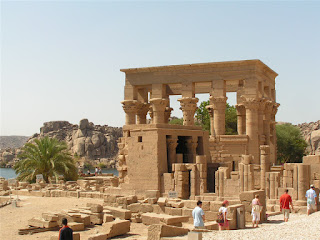
Philae, Trajan's Kiosk

Trajan's Pavilion

Temple hieroglyphs on stone at Philae
Boats land near the oldest structure on the island, the Vestibule of Nectanebo I, beyond which lies a large court flanked by two elegant colonnades and the impressive first pylon of the temple of Isis. The small door to the left leads into a 3rd century BC Birth House, whose outside back wall shows some lovely scenes of Isis nursing Horus in the marshes. The main gate with two granite lions, leads to the second pylon, opening up to a Hypostyle Hall. The inner temple lost most of its decoration when it was converted into a church around AD 553, but the Sanctuary still contains Isis’s sacred barque, has a wonderful relief of the gods playing Kiosk of Tranhan, with its superb views across the lake.
Boat trip to Philae Temple:
The boat trip from the marina to Agilkia Island is short, but filled with picturesque scenery. As the boat ripples through the tranquil waters of the Nile, small waves crash into even smaller islets made up of formations of titanic round rocks that decorate the path towards the island. Eventually, Philae Temple appears gloriously on the horizon.
Around the small marina on Agilkia, Nubian merchants sell colourful hand-made jewellery, wooden Nubian miniature dolls and animals, straw hats and pottery pots. Speaking multiple languages, merchants approach visitors to present their wares. However, visitors can hastily climb up the gradient to meet face to face with the temple.
Entering the open-court of pillars, the temple is vast and epic. Philae was built during the Greco-Roman era under the Ptolemaic dynasty. The temple’s construction lasted over 600 years and was dedicated to worshiping the goddess of motherhood and love, Isis, who was a deity for the Romans in Egypt. Unlike most temples in Egypt, each pillar at Philae in the open-court is topped with a lotus flower, some flowers open while others are closed. This inconsistency was intentional to mimic and also differentiate between the style of the Pharaohs and that of the Ptolemaic dynasty. Ceremonial processions, enthroning or reaping occasions once took place in this court.

Trajan's Kiosk
Moving on to the pylon (the second structure in Egyptian temples), the number of entrances to the temple indicated how many gods or goddesses to which the temple was dedicated. This is why Philae has one gate devoted for Isis. The walls of the pylon have inscriptions of the Ptolemaic kings giving offerings to goddess Isis. The third part of the temple is a closed hall of pillars which contains the room where Horus, son of Isis is said to have been born. It is worth noting that the inscriptions on pillars of the temple were a mixture of Pharaonic and Greek languages. This leads to the most scared part of the temple, the sanctuary where sacrifices and offerings were kept.


