Philae Temple

The splendid Philae Temple (temple of Isis), set on an island surrounded by the blue waters of Lake Nasser, is one of Egypt’s most romantic sights, especially as you arrive by boat. For more than 800 years, until AD 550, this temple to Isis and Osiris was one of the most important Egyptian cult centers.

Ptolemaic and Roman rulers, keen to identify them selves with this powerful ancient Egyptian cult, all added their mark, making for an interesting blend of styles. The worship of Isis as the Mother of the Gods eventually spread all over the Roman Empire, and early Coptic art clearly associates the Virgin Mary and baby Jesus with Isis suckling her infant son Horus.


 The temple of Isis from Philae 


Originally the temple of Isis was built on the island of Philae facing Bigah Island, which was believed to be one of the burial sites of Osiris. But Bigah was accessible only to priests, so all the religious festivities took place on Philae. With the building of the first Aswan Dam the temple was submerged for half the year. In the 1970s when the High Dam threatened to submerge it completely, UNESCO and the Egyptian Antiquities organizations painstakingly moved the entire complex to nearby Agilkia Island, which had been landscaped to resemble Philae.


Philae. Columns


First Pylon and Columnade, Philae


Philae, Trajan's Kiosk
 
 
Trajan's Pavilion


Temple hieroglyphs on stone at Philae


Boats land near the oldest structure on the island, the Vestibule of Nectanebo I, beyond which lies a large court flanked by two elegant colonnades and the impressive first pylon of the temple of Isis. The small door to the left leads into a 3rd century BC Birth House, whose outside back wall shows some lovely scenes of Isis nursing Horus in the marshes. The main gate with two granite lions, leads to the second pylon, opening up to a Hypostyle Hall. The inner temple lost most of its decoration when it was converted into a church around AD 553, but the Sanctuary still contains Isis’s sacred barque, has a wonderful relief of the gods playing Kiosk of Tranhan, with its superb views across the lake.

Boat trip to Philae Temple:

The boat trip from the marina to Agilkia Island is short, but filled with picturesque scenery.  As  the  boat  ripples  through  the  tranquil  waters  of  the  Nile,  small  waves crash  into  even  smaller  islets  made  up  of  formations  of  titanic  round  rocks  that decorate the path towards the island. Eventually, Philae Temple appears gloriously on the horizon.

Around  the  small  marina  on  Agilkia,  Nubian  merchants  sell  colourful hand-made jewellery,  wooden  Nubian  miniature  dolls  and  animals,  straw  hats  and  pottery pots. Speaking  multiple  languages, merchants  approach  visitors  to present  their  wares.  However, visitors  can  hastily  climb  up  the gradient  to  meet  face  to  face with the temple.

Entering the open-court of pillars, the  temple  is  vast  and  epic. Philae  was  built  during  the Greco-Roman  era  under  the Ptolemaic dynasty.  The temple’s construction  lasted  over  600 years  and  was  dedicated  to worshiping  the  goddess  of motherhood and love, Isis, who was a deity for the Romans in Egypt. Unlike most temples in Egypt, each pillar at Philae in the open-court is topped with a lotus flower, some flowers open while others are closed. This  inconsistency was intentional to mimic and also differentiate between the style of the Pharaohs and that  of  the  Ptolemaic  dynasty.  Ceremonial  processions,  enthroning  or  reaping occasions once took place in this court.
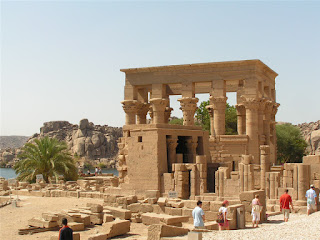
Trajan's Kiosk


Moving on to the pylon (the second structure in Egyptian temples), the number of entrances  to  the  temple  indicated  how  many  gods  or  goddesses  to  which  the temple was dedicated. This is why Philae has one gate devoted for Isis. The walls of the pylon have inscriptions of the Ptolemaic kings giving offerings to goddess Isis. The  third  part  of  the  temple  is  a  closed  hall  of  pillars  which  contains  the  room where  Horus,  son  of  Isis  is  said  to  have  been  born.  It  is  worth  noting  that  the inscriptions  on  pillars  of  the  temple  were  a  mixture  of  Pharaonic  and  Greek languages. This leads to the most scared part of the temple, the sanctuary where sacrifices and offerings were kept.

Medinet Hebu

Location of Medinet Hebu:

The  west  bank  at  Luxor  is  one  of  the  most important  archaeological  sites  in the  world. Thebes,  located  opposite  of  today’s  city  of Luxor,  was  the  capital of  Egypt  during  the period of the Middle and New Kingdoms. With the  temples and  palaces  at  Karnak  and  Luxor, and the necropolises of the Valley of the Kings and  the  Valley  of  the  Queens,  Thebes  is  testimony to Egyptian civilization at its height.

Temple of Medinet Hebu:

Medinet Hebu was both a temple and a complex of temples dating from the New Kingdom. The  area  was  one  of  the  earliest  places  within the  Theban  region to  be  associated  with  the worship of Amun. Hatshepsut and Tutmosis III built a small temple to Amun on the site of an the  site  of  an  earlier  structure.  Next  to their temple, Ramesses III built his mortuary temple, Medinet  Hebu’s  most conspicuous  standing monument.  Medinet  Hebu  was  erected  and enclosed with  massive  mud  brick-built  walls and became the focus of the administrative and economic life of the whole of Thebes. The  area  included  storehouses, workshops, administrative offices, and residences of priests and  officials.  The site  was  inhabited  well  into the Middle Ages (9 th  century A.D.). The original temple  underwent  many  alterations  and enlargements  in  the  following  1500 years. These considerably extended its plan by adding a columned hall, two pylons, and a court at the front.


Mortuary Temple of Ramesses III - sky view


The temple at Medinet Hebu of Ramesses III at Qurna


 Ramessid columns in the peristyle court


Ceiling decoration in the peristyle hall


Zone of decolourisation in court of mortuary temple of Ramesses III


The Mortuary Temple of Ramesses III


The  mortuary  temple  used  to  be  connected with the Nile by a canal, and a landing quay was built outside the enclosure wall. The entrance to the  temple enclosure  was  through  one  of  two fortified  gates,  of  which  only  the  eastern so-called "Pavilion" now remains. South of the last court  stood  the  brick-built palace,  now  badly damaged. Two building phases of the structure can  be recognized.  The  interior  of  the  palace was originally decorated with exquisite faience tiles.  The  "window  of  appearances"  connected the palace with the temple.


The Coptic Fresco of Saint Menas at Medinet Hebu:
Saint Menas has received his due share of attention  in religious literature, both in connection with  incidents  of  his  life  and  the  miracles which  he  performed, and  thus  it  is  surprising  to  find that none of the scenes at Medinet Hebu seem to portray incidents common to the literary record. The fact that such a concordance could not be established in a preliminary analysis has  necessitated  a detailed  study  of  the  documentary  material  concerning  the saint. Earlier studies of Menas have settled  neither the problem of where the saint was born and where he lived, nor the problems regarding the relations between his appearance on objects of art and the material of the literary legends.  The results of an investigation of these questions must  be given before the paintings can be considered in detail.

Ricostruzione dell’affresco di Medinet Hebu

Akhenaten's Hymn to Aten

Worship (Re-Horakhty who Rejoices in the Horizon) (In his Name as the Shu who is in the Aten Living forever and ever, the  Living Aten, the Great One who is in Jubilee, Master of all that the Aten encircles, Master of Heaven, Master of the Earth, Master of the Per-Aten in Akhet-Aten; and the King of Upper and Lower Egypt, the one Living on Maat, Master of Regalia (Akhenaten), the long Lived; and the Foremost Wife of the King, whom he loves, the Mistress of Two Lands (Nefernefru- Aten Nefertiti), living, well, and young forever and ever. He says:

The praise of the sun-god Thou appearest beautiful in the horizon of the sky, O living Disk, beginning of life! When thou risest in the eastern horizon, Thou fillest every land with thy beauty. Thou art beautiful, great, Resplendent and exalted over every land. Thy rays encompass the lands To the extent of all things which thou hast made; (Since) thou art Re, thou bringest then all, Thou subjectest them to thy beloved son (though) thou art afar, thy rays are on earth; Thou art on their faces (and thus they feel?) thy steps.

(When) thou goest to rest in the western horizon, The earth is in darkenss, in the condition of death. (Men) lie in their chambers with their heads wrapped up; One eye seeth not the other. Their belongings are stolen (even when) lying under their heads, And they notice it not. Every lion cometh from his den, All serpents bite, Darkness (is their protection?) The earth (resteth) in slience (While) he who made them is in his horizon.

The earth is bright when thou risest on the horizon, Resplendent as the sun disk in day-time. Thou removest darkness (When) thou sendest thy rays. Both lands are in festival joy, Awakening and standing on (their) feet; Thou hast raised them up. Their limbs being bathed, they take (their) clothing; their arms are (lifted) in worship at they rising; (Thereupon) all the land perform their toil. All cattle rejoice in their grass; Trees and herbs are greening The birds are flying from their nests (seshu) Their wings are (lifted) in worship to thy being; All (wild) animals skip on their feet; the birds and all things fluttering (Feel) alive when thou hast arisen for them. The ships sail (on) the stream up and down alike; Every way is open when thou arisest. The fish in the rivers leap before thee; Thy rays are in the innermost of the great ocean.

Creator of issue in women, Maker of seed in men, who preserveth alive the son in his mother's womb And keepeth him quiet that he weep not, A nurse (for him even) in the (maternal) womb. Who giveth breath to keep alive all that he maketh; (When) it descendeth from the womb on the day of its birth; Thou openest its mouth, giving it voice; Thou makest what it doth need.

The young bird crieth in the shell (Because) thou givest it breath within to preserve its life. When thou hast given it strength to open the egg, It cometh from the egg to cry with full strength. It runneth on its feet When it cometh forth from it.

How manifold are (the things) which thou hast made! They are mysteries before Thou only god, whose place none else can take!

Thou hast created the earth according to thy heart Thou being alone Men, flocks, and all animals, Whasoever is on earth, Going on feet, Whatsoever is high in the air, flying with its wings, The foreign lands, Syria and Ethiopia, (And) the land of Egypt.

Thou assignest every man to his place, Thou makest what they need. Each one hath his food, and his lifetime is counted. The tongues are distinguished in speech; their forms and their skins are differentiated; (Thus) thou didst distinguish the strange nations.

Thou madest the Nile in the lower world. Thou bringest him according to thy liking. For furnishing life to mankind, As thou hast made them for thyself, Thou, their lord, (lord) of them all, Resting among them, Thou lord of every land Who ariseth for them, O sun-disk of the day, great of power!

All foreign countries, the remote, thou makest life for them; (Because) thou has placed a Nile in the sky, It descendeth for them; It maketh waves on the mountain like the great ocean, irrigating their fields in their towns.

How excellent are thy plans, O lord of eternity! Thou (hast established) the Nile in the sky for the foreign lands and for the wild beasts of every mountain country wandering on their feet; (But) the Nile cometh from the underworld for Egypt.

Thy rays nourish every green spot; (When) thou risest, they live and they grow for thee.

Thou hast made the seasons To produce all that thou makest; The winter to cool them, The (season of) heat (when) they (really) taste thee. Thou didst make the sky far away to rise in it and to behold all that thou makest.

Thou art alone, rising in thy forms as a living disk, appearing, shining, departing, and (again) drawing nigh. Thou makest millions of forms from thyself alone, Cities, villages, and tribes, Highways and rivers; every eye beholdeth thee before them (When) thou art the disk of day-tiem above (them). "Thou art in my heart. None other is there who knoweth thee except thy son, Akh-en-aten; Thou hast made him wise in thy plans and in thy power.

The (whole) earth is at thy command as thou hast made them. When thou hast risen, they (feel) alive. When thou hast set, they (feel) deed. (Thus) in thyself thou art lifetime; People live from thee; (All) eyes (are fixed) on they beauty until thou settest; All work is stopped (when) thou settest in the west.

Arising, thou makest (everything good) grow for the king Who hath been a servant following thee for thou hast founded the earth And raised it up for thy son, the one who came forth from thy limbs, the king of Upper and Lower Egypt,  Living in truth, lord of both countries,

Nefer-khepru-re (The Best of the Forms of the Sun) Ua-n-re (The Only One of the Sun) Son of the sun, living in truth, the lord of diadems, Akh-en-aten. Long (be) his life, And the chief royal wife, beloved of him, The mistress of both countries, Nefer-nefru-aten, Nefert-iti, Who liveth and flourisheth for ever and for eternity.

The City of Akhenaten (Amarna)

Pharaoh Akhenaten, his beautiful wife Queen Nefertiti, and his son Tutankamun were all part of this dynasty. During this time one of the most dramatic changes in Egypt took place: Akhenaten built a new city, Amarna, for a god named the Aten, and outlawed all other gods. The Amarna period, sometimes called “The Amarna Experiment,” resulted in some of the best-known art, tombs, writing and records of ancient Egypt. That is why, even though the period was only around 30 years long, it is one of the most famous in Egyptian history.

Imagine you could have the power to shape the world around you to build a city, change a religion and live as the representative of god on earth. It’s hard for people today to think of this kind of power, but it was the power that Pharoah Akhenaten wielded in Egypt during the Amarna period.

During his rule, from 1353 to 1336 BCE, Akhenaten changed Egyptian life in a big way. He moved the capital city of Egypt from Thebes to Amarna, then known as Akhetaten, a city he constructed on what had been just a piece of desert. There he created a new religion, new religious leaders and new temples. His influence lived on beyond his death.

Amarna

Visualization  of  an  Atenist  temple

You may know that throughout their history, ancient Egyptians worshipped many gods and goddesses. These deities each had histories and Egyptians believed they interacted with each other. Together, they were believed to influence everything from health to rainfall to the afterlife.

Everyday Egyptians kept images of the gods and goddesses in their homes, and communicated with them. Making offerings, celebrating religious holidays and preparing complex funerals were all a part of Egyptians’ constant interactions with their gods.

Akhenaten was born into this world of many gods. At that time, Amun Re was the most important of the Egyptian’s gods. Amun Re was a mysterious god with many abilities, but he appeared to the people as the sun. A powerful group of priests served Amun-Re.

When Akhenaten became king around 1353 BCE, he began to make changes. He declared that there was only one god who could be worshipped - the Aten —- and he declared that as the pharaoh he was the only person who could communicate with this god. Why did Akhenaten make this huge change? Some people think he wanted to get rid of the powerful priests of Amun Re, whose power could challenge the pharaoh’s. Other people think that Akhenten was totally dedicated to the Aten, and that he was one of the first people in history to express unique and personal thoughts on spirituality. The Aten literally meant “the disk of the sun.” Akhenaten searched for a place to build a new city for the Aten.He found it in a spot where the sun appeared to rise from an eastern valley and spread its light over a broad piece of land in front of the Nile River. The new city was named Amarna, “horizon of the Aten.”

The pharaoh lived at Amarna with his family. As a result, all the government officials, artists, builders and families who served the king moved there, too. Life in Amarna revolved around the Aten.

As the population grew, the city stretched north and south along the Nile, which was the source of water for the wells the people of Amarna dug into the desert. Official royal buildings and the temples of the Aten were concentrated in the heart of the city. Suburbs, where most people lived, surrounded the center of the city.

Pectoral of Tutankhamun

Pectoral of Tutankhamun:


1- This is a Pectoral, or chest ornament, which was worn by both men and women. It was discovered intact in the tomb of Tutankhamun. The piece depicts Scarab Beetles or Khepri, pushing the sun.

Khepri was believed to be a Sun god by the ancient Egyptians, and was represented as a scarab beetle. The jewel is also decorated with inlaid lotus blossoms, which hang at the bottom.


2- Winged Scarab Pectoral of Tutankhamun:

Winged Scarab Pectoral of Tutankhamun, is filled with symbolism, made with semi-precious stones (carnelian, lapis lazuli, glass,) and with a lotus blossom fringe.

The symbols of the Ankh and the Eye of Horus (Udjat) are among the most used in ancient Egyptian Art.


3- Golden pendant of Tutankhamun: 

This pendant made with a method called Cloisonné and inlaid with semiprecious stones and colored glass. It is full of symbols and hieroglyphs.

The central element of the composition is a winged scarab with a yellow stone of disputed origin which  grasps on one side a lotus and on the other a papyrus flower, flanked by two uraei (cobras.).

A gold frame outlines the main composition and supports pendants of lotus flowers, papyrus, and poppy seed heads.  

A slim solar boat rests upon the front feet of the scarab and carries the Udjat eye of Horus, flanked by two cobras. The Udjat eye is surmounted by a lunar crescent of gold and a silver disk with images of the gods, Thoth and Re-Horakhty, crowning the central figure of the king. 


4- Tutankhamun’s Necklace with a Pectoral in the Form of a Solar Boat:

This pectoral is centered on a scarab of lapis lazuli, that symbolizes the god, Khepri.  

Khepri represents the sun on the horizon of the new day. The scarab holds a solar disc of carnelian surrounded by a gold rim. The beetle is flanked by two baboons with lunar symbols on their heads.  

This item was discovered inside an inlaid box of ebony and ivory with an inscription that read: "gold jewelry for the funerary procession from the bedchamber of Nebkheperure.” This was Tutankhamun’s coronation name. 


5- Tutankhamun’s Necklace of the Sun on the Eastern Horizon:

The artist who made this Pectoral used the hieroglyphic sign for 'horizon' (akhet), which represents the sun rising between two mountains, with the scarab ( the sun-god) pushing the sun in front of it He has also added uraei (cobras) with pendent 'life' signs (ankh) to the 'horizon' hieroglyph, showing that the rising sun is bringing life to Upper and Lower Egypt.

On the symbol for the sun-god's gold barque (boat) are two uraei, one in the prow and the other in the stern; on their heads are disk of the sun and their tails are  replaced by three amulets symbolizing 'goodness' (nefer), 'life' (ankh) and 'stability' (djed). 

The straps of the pectoral are made of separate inlaid gold plaques held together at the back and the sides by rows of small gold, carnelian and glass beads. The plaques use the same elements as those in the pendant, except that the sun's disk is substituted for the sign of the horizon, and  the hieroglyphic sign for 'festival' is placed beneath the scarab. 


6- Gold cuff bracelet of Tutankhamun:

This gold cuff bracelet is composed of two semicircles joined together by a hinge on one side and a clasp on the other.  

The central plaque bears a cloisonné scarab inlaid with lapis lazuli. The scarab, symbol of the morning sun, was the most popular motif used in jewelry. The bracelet itself is also inlaid with carnelian, lapis lazuli, turquoise, quartz, and colored glass. 


7- A Pectoral of Tutankhamun with Eye of the god Horus:

A Pectoral of Tutankhamun, dominated by the Eye of the god, Horus (the Udjat).

Pectoral of Senusret II

Pectoral of Senusret II from the tomb of Sit-Hathor Yunet, daughter of Senusret II, found at El Lahun. This cloisonné pectoral is inlaid with 372 carefully cut pieces of semiprecious stones.

Pectoral of Senusret II

Hieroglyphic signs make up the design, which read: "The god of the rising sun grants life and dominion over all that the sun encircles for 1,100,000 years (eternity) to King Khakheperre [Senusret II]." Zigzag lines on the base bar represent the primordial waters out of which the primeval hill emerged. Each of the falcons, symbols of the sun god, clasps a circular hieroglyph meaning "encircled," thus declaring the solar deity's supreme power over the universe. The same hieroglyph, elongated to form a cartouche, encircles the throne name of Senusret II, Khakheperre.

Flanking the king's name are two ankh hieroglyphs (meaning "life") suspended from cobras whose tails are wound around the sun disk on the falcons' heads. These snakes represent Nekhbet and Udjo, the traditional protector goddesses of the king. Supporting the royal cartouche is the kneeling god Heh clutching two palm ribs symbolizing "millions of years.

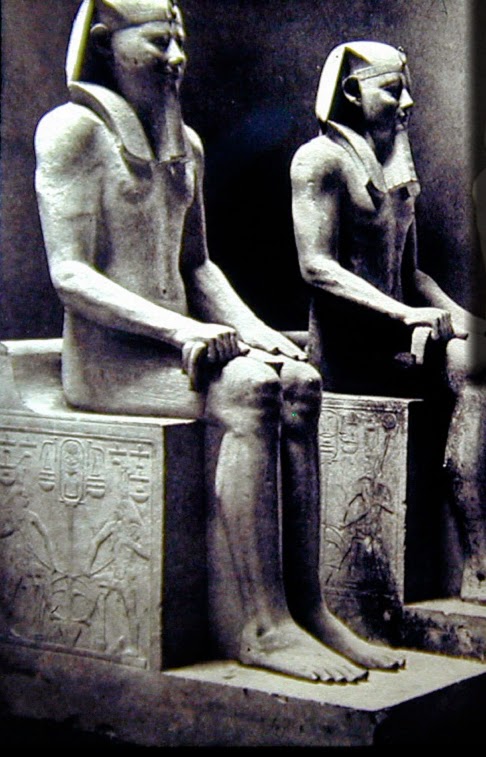
Sculptures of Sensuret III

     Some of the finest examples of sculpture during the Middle Kingdom were at the height of the empire under Pharaoh Senusret III. Senusret III is known for his strikingly somber sculptures. Senusret III is considered to be perhaps the most powerful Egyptian ruler of the dynasty, and led the kingdom to an era of peace and prosperity.

     Senusret III is known for his strikingly somber sculptures in which he appears careworn and grave. While many statues portray him as a vigorous young man, others deviate from this standard and illustrate him as mature and aging. This is often interpreted as a portrayal of the burden of power and kingship. Another important innovation in sculpture during the Middle Kingdom was the block statue, which consisted of a man squatting with his knees drawn up to his chest.

     During the Middle Kingdom, relief and portrait sculpture captured subtle, individual details that reached new heights of technical perfection. Some of the finest examples of sculpture during this time was at the height of the empire under Pharaoh Senusret III.


     Khakhaure Senusret III (also written as Senwosret III or Sesostris III) ruled from 1878 BC to 1839 BC, and was the fifth monarch of the Twelfth Dynasty of the Middle Kingdom. His military campaigns gave rise to an era of peace and economic prosperity that not only reduced the power of regional rulers, but also led to a revival in craftwork, trade, and urban development in the Egyptian kingdom. One of the few kings who were deified and honored with a cult during their own lifetime, he is considered to be perhaps the most powerful Egyptian ruler of the dynasty.

     Aside from his accomplishments in architecture and war, Senusret III is known for his strikingly somber sculptures in which he appears careworn and grave. Deviating from the standard way of representing kings, Senusret III and his successor Amenemhat III had themselves portrayed as mature, aging men. This is often interpreted as a portrayal of the burden of power and kingship. That the change in representation was indeed ideological and should not be interpreted as the portrayal of an aging king is shown by the fact that in one single relief, Senusret III was represented as a vigorous young man, following the centuries old tradition, and as a mature aging king.

     Another important innovation in sculpture that occurred during the Middle Kingdom was the block statue, which would continue to be popular through to the Ptolemaic age almost 2,000 years later. Block statues consist of a man squatting with his knees drawn up to his chest and his arms folded on top of his knees. Often, these men are wearing a wide cloak that reduces the body of the figure to a simple block-like shape; in some cases the cloak covers the feet completely, and in others the feet are left uncovered. The head of the sculpture contains the most detail.

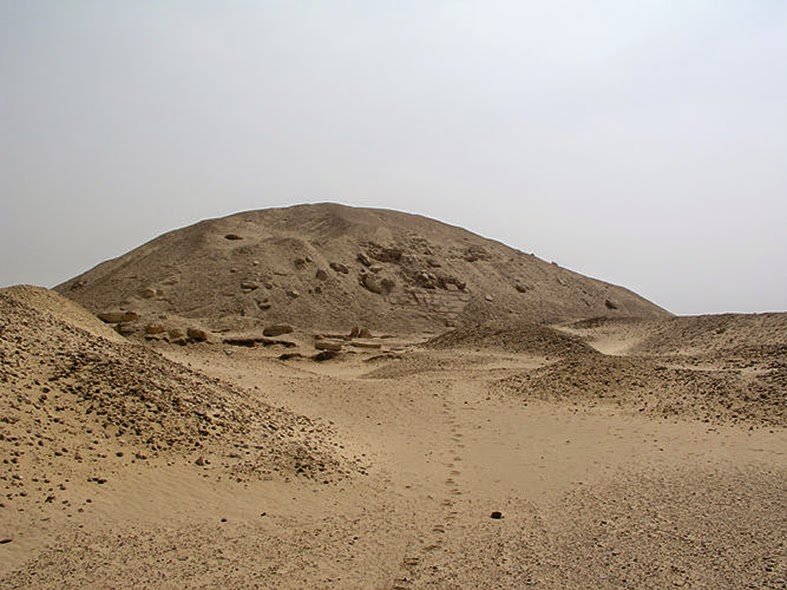
The Pyramid of Senusret I

     Senusret I followed this revival and constructed a pyramid about 1.61 km to the south of Amenemmes I’s complex. The pharaoh Senusret I ruled from about 1971 to 1926 B.C.E., during the Middle Kingdom. He was a strong leader who ruled a stable, unified Egypt. Art, literature, and architecture flourished during his reign.

   Craftspeople thrived under Senusret’s rule. The pharaoh controlled mines loaded with gold, copper, and gems such as purple amethyst. Craftspeople fashioned these materials into beautiful pieces of jewelry. Bracelets and necklaces were often highly detailed. They were then decorated with stones like turquoise.

   Some of the greatest works in Egyptian literature were written during Senusret’s reign. “The Story of Sinuhe” tells of a young official named Sinuhe who overhears a plot to kill the pharaoh. Fearing for his own life, Sinuhe flees Egypt. He thrives in his new land, but he grows very homesick. When a new pharaoh calls him home, Sinuhe returns joyfully. Senusret’s greatest accomplishments were in religious architecture. He built and improved many temples, shrines, and religious monuments.


   Perhaps Senusret’s finest architectural achievement was the White Chapel. (A chapel is a small temple.) It was made of alabaster, a hard white stone. Some historians think the chapel was originally covered in a thin layer of gold.

   Beautiful artwork decorated the chapel’s pillars. Carved scenes showed the pharaoh with various gods. Birds, animals, and Egyptian symbols were also depicted. Senusret wanted his memory to live on through his monuments. But almost none of his buildings survived the passage of time. A later pharaoh took the White Chapel apart and used the pieces in a monument of his own. Archeologists later discovered the pieces and reconstructed the White Chapel.

   Another important find which illustrates a strong association between Egypt, Asia and the Aegean is the El-Tod treasure. This was discovered in 1936, buried in the stone foundations of a temple at El-Tod in Egypt which, the archaeologists believed, was built by King Senusret I of the Middle Kingdom.

The Boundary Stelae of Akhenaten

     Boundary Stella of Akhenaten still survive today bearing testimony to the accurate surveying skills of the Cadastre Scribes, three on the western side of the Nile cut into limestone cliffs along the edge of the cultivation and twelve to the east following the hills that form the desert bay next to the river in the area now known as El-Amarna.

     The Boundary Stella of Akhenaten, shows that both pairs of princesses on each side of this Stella were holding hands, whereas the hand on the present figure's right shoulder indicates that she was joined in embrace with her sister.


     The boundary Stella of Akhenaten describe the founding of the city. The numerous rock tombs, some decorated with papyrus columns, were built hidden in the cliffs to protect them from thieves and flash floods. The famous lyrics of the 'Hymn to the Sun', composed by Akhenaten, is found in each tomb.

     The boundary Stella of Tell el-Amarna were probably carved in the years 6 to 8 of Akhenaten's reign.

Akhenaten Statues

The Amarna Period was centered around the capital city of Amarna and noted for its artistic style, which drastically shifted from conventional styles of art. The human body in the Amarna style is portrayed more realistically, rather than idealistically, though at times depictions border on caricature. Common features are an elongation and narrowing of the neck, a sloping of the forehead and nose, a prominent chin, large ears and lips, spindle-like arms and calves and large thighs, stomachs, and hips.

The decoration of the tombs of non-royals was quite different from previous eras, and clearly worshiped the Aten over other gods and goddesses. Not many buildings from this period have survived the ravages of later kings, partially as they were constructed out of standard-size blocks which were very easy to remove and reuse. Much of what we know of the Amarna period today comes from the discovery of the Amarna Letters: a cache of over 300 tablets recording select diplomatic correspondence of the Pharaoh.

Akhenaten was a pharaoh of the 18th dynasty who is best known for ushering in a
distinctly new art style known as Amarna Art.

Akhenaten Statues:

1- Akhenaten, Nefertiti and their children. This relief illustrates an intimate portrait of
Akhenaten and his family in the Amarna style of art.


2- A relief portrait of Akhenaten. Akhenaten represented in the typical Amarna period style.
New Kingdom, 18th dynasty, circa 1345 B.C.


3- Artist’s sketch: Walk in the Garden; limestone; New Kingdom, 18th dynasty, c. 1335 BC. A relief of a royal couple in the Armana style. The figures are thought to be Akhenaten and Nefertiti, Smenkhkare and Meritaten, or Tutankhamen and Ankhesenamun.


4- Akhenaton, pillar statue from the Temple of Amen-Re, Karnak, Dynasty XVIII, c. 1355-1335 BCE. Sandstone, approx. 13’ high.

He also has all the accoutrements of kingship:

13 feet in height

The cobra crown.

The false beard.

The crook and flail in his hands (the crook has been damaged).

The royal cartouches on his stomach and collar bones.


Senusret III's Canal

     The trade with Ethiopia and Nubia, the region between the First Cataract and the district now known as the sudd region, was on an entirely different basis. A good deal of trade had taken place in predynastic times by means of market to market trading, and this market to market trading continued during the Old Kingdom and the Middle Kingdom. We know of two great markets, Assuan itself (meaning ‘ Market Place ’) and another at the Second Cataract called Iken. But the bulk of the material as far as it was in large quantities must have been transported by water in the protodynastic times. This fact requires an understanding of navigation in the cataract region. During high water (July to October) the cataracts are navigable by ships of moderate size. At the present time the date harvest of Dongola is carried to Wadi Halfa by sailing boats which make two to four trips a season. The difficulty comes in the other eight months, when the water is low and the cataracts are filled with water swirling among the half-exposed rocks.

     The first hint of the opening of a way through the nearest of the cataracts, that at Assuan, is in Dynasty VI. In his autobiography, Weny, a great official of Mernera, relates that His Majesty sent him to Wawat to dig five canals and to construct seven boats for the transportation of granite to Memphis, three cargo boats and four towing boats (manned by rowers). Wawat lies in the granite and sandstone region between the First and the Second Cataract, and there can be little doubt that the five canals were made in the First Cataract itself to permit the passage of these boats loaded with granite for the king’s pyramid. The operation would have consisted in shifting aside a number of boulders at five different places, probably along the western side, to secure quiet passage around the most dangerous places, no great matter for the experienced stone workers who built the pyramids. But we have no knowledge of the size of the canals or as to how long they continued in use.  Weny states that he accomplished the whole business, including the building of the necessary boats, the making of the canals, and the removal of the stones, in one year.


Labels