Temple of Kom Ombo

    Kom Ombo A site south of EDFU on the Nile that served as the cultic center for the deities HORUS the Elder and SOBEK, Kom Ombo was also a major center of Egyptian  TRADE with  the  Red  Sea  and  Nubian  (modern Sudanese)  cultures.  Eighteenth  Dynasty  (1550–1307B.C.E.) structures made Kom Ombo important, but there were also settlements from the Paleolithic Period in the area.


Temple of Sobek and Horus at Kom Ombo
From
Bunson (M. R.), Encyclopedia of ancient Egypt, New York, 2002.


Temple of Kom Ombo 


Papyrus shaped columns at Kom Ombo temple 


The gate to access to the sanctuary of Sobek


Column details at Kom Ombo 


Relief stone outside the temple


Nilometer outside the temple


    The temple of Haroeris (HORUS) and SOBEK was a double structure, with identical sections, the northern one for Haroeris and the southern one for Sobek. There was also a shrine to HATHOR on the site. The complex was dedicated as well to KHONS (1). Tasenetnofret, an obscure goddess called “the Good Sister,” and Pnebtawy, called“the Lord of the Two Lands,” were honored as well at Kom Ombo.

    A double entrance is in the southwest, leading to a courtyard. Two HYPOSTYLE HALLS, offering halls, twin sanctuaries, magazines, vestibules, wells, and birth houses, called MAMMISI, compose the elements of the temple. The main temple is Ptolemaic in its  present  form, with a gate fashioned by PTOLEMY XII Auletes (r. 80–58, 55–51 B.C.E.). Niches and crypts were also included, and mummies  of  CROCODILES were  found,  wearing  golden earrings,  manicures,  and  gilded  nails.  A  NILOMETER was installed at Kom Ombo, and CALENDARS and portraits of the Ptolemys adorned the walls.

Karnak

   The temples at Karnak are the largest ancient complex in Egypt. Begun in 1970 BC by Sesostris I, construction continued through the reign of Ramses III in 1166 BC. Each Pharaoh of those 800 years wanted to leave something of himself here – a new temple, chapel, or carvings of himself superimposed over older carvings.

   The Great Hypostyle Hall, comprised of the huge columns seen to the right, is one of the greatest achievements of Ancient Egypt, considered as difficult to achieve as the Great Pyramid at Giza.

Karnak Temples

Gate of Karnak

statues of Ram at Karnak

Pillars of the Great Hypostyle Hall

The Sacred Lake

 From karnak temple


Abu Simbel Sun Festival

For most of the year, the inner sanctum of the main temple at Abu Simbel is shrouded in darkness. On two specific days, traditionally the anniversary of the birthday and coronation of pharaoh Ramses II, a shaft of sunlight pierces the gloom, illuminating statues of gods and the king in the temple’s inner sanctum.

Temple of Abu Simbel

On February 22, a day celebrating the king’s birthday and again on October 22, a day celebrating his coronation, sunlight illuminates seated statues of the sun gods Re-Horakhte and Amon-Re, as well as a statue of king Ramses II. The statues sit in the company of the Theban god of darkness, Ptah (who remains in the shadows all year).

Abu Simbel Sun Festival

The sun illuminating Abu Simbel is considered to be one of the oldest Egyptian Sun Festivals, it dates back to the pharaonic era and has endured more than 3,200 years of Egyptian history. It draws thousands of tourists to Abu Simbel to watch this ancient tribute to a pharaoh whose name is still known up and down the Nile Valley and the world over for his military exploits and monumental building projects. Nowadays, it became a touristic attraction due to the high dam and the moving of the temple.

During the spectacle, people stand in two rows to let the sun rays reach the statues in the shrine.

The Unfinished Obelisk, in Aswan

The Unfinished Obelisk is a huge obelisk yet to be finished. If finished, it would have measured around 41 m and would have weighed nearly 117 tons. Its importance lies in the fact that it carries inscriptions that explain the methods the ancient Egyptians used in cutting and sculpting obelisks.


The Unfinished Obelisk, in Aswan

Egypt Nile Cruises

The pharaohs sometimes visited their Nile-side temples by royal barge, and boat traffic along the river remains the most  dramatic way to reach the monuments. Since 1869,  when Thomas Cook and Son launched  their Upper Egypt excursions, steamships were popular with those who wished to travel in style, and see the sites at a comfortable pace. While some of today’s cruise ships are nearly as well-appointed as the royal barge, there are packages to suit every budget, offering itineraries of varying lengths.


Egypt Nile Cruises


Several jewellike monuments are located on the banks of the river between Luxor and Aswan, including the Temple of Khnum at Esna, the Temple of falcon-headed Horus at Edfu, and the  temple of the  crocodile  god Sobek at Kom Ombo. All may be visited by car from Luxor, as well as by cruise ship to Aswan, south of Luxor, whose attractions  also merit an extended stay.

Note:

From Aswan you may embark on a (3 to 4) night Lake Nasser cruise to Abu Simbel, visiting the monuments of Nubia along the way.

Luxor Temple

This magnificent structure, know in ancient times as the “Harem of the South” is
connected to the Temple of Karnak by a 3Km processional Avenue of Sphinxes, like
Karnak, Luxor’s temple was dedicated to the Theban triad of Amun, Mut and Khonusu,
whose statues stood here during the Opet festival.

Even though Luxor Temple was expanded several times throughout the ages, it’s much
more compact and coherent than Karnak, perhaps because its core was built by just one
pharaoh, Amenhotep III. The walls are decorated with some of the finest carvings in
Egypt, protected because much of the temple was buried until 1885. Before excavations,
only the heads of the Ramses II colossi and the tips of the obelisks stuck out above the
pile of debris on which Luxor village was built. The village was removed bit by bit as the
excavations started.


Luxor


Luxor at night


Luxor temple


Luxor temple (at Night) 


Luxor temple (entrance)


Avenue of Sphinxes leading up to Luxor Temple


Courtyard of the Luxor Temple
 

The Avenue of Sphinxes leads to the monumental fist pylon built by Ramses II, which
was once fronted by two obelisks and six colosii of the man himself. The pylon is
decorated, as so many other Egyptian temples, with Ramses II’s favorite story the battle
of Qadesh. Beyond the pylon, the large Court of Ramses II is surrounded by two rows of
papyrus-bud columns, interspersed with more statues of the king.

Beyond the second pylon the impressive Processional Colonnade of Amenhotep III, with
huge papyrus columns, was the model for the Great Hypostyle Hall at Karnak. The
craving on the walls was added by Tutankhamun and gives a picture of the Opet
celebration: One wall shows the outward journey, the other the return of the procession.
At the end of colonnade is the temple’s most impressive part, the Great Sun Court, also
built by Amenhotep III, its fine decorations developed over the millennium between the
reigns of Amenhotep and Alexander the Great.

Unfortunately this court has suffered badly from the rising water level and a major
restoration project is underway. Behind a columned portico, used as a chapel by Roman
soldiers, lays the temple’s inner sanctuary, with Alexander the Great’s Sanctuary of
Amun’s Barge and Amenhotep III’s Birth Room, and his nurturing by goddesses. The
bedrock on which this part of the temple was built was believed to be the site where
Amun was born.

Salvage Operation of Abu Simbel Temple

The rescued Nubian temples were moved and re-assembled in new locations: the  temples of Philae on the island of Agilika, near the old Aswan Dam ; the temples of Beit al-Wali,  Kalabsha and the kiosk of Qertassi a few hundred meters south of the High Dam; the temples of Wadi El-Sebuâ, Dakka and Maharraqa, 140 km south of the High Dam; the temples of Amada, Derr and the tomb of  Pennut, 180 km from the High Dam ; and the two temples of Abu Simbel, 270  km  from  the  High  Dam. Four  Nubian  temples  were offered to countries that had provided significant assistance in the salvage operation: the temple of El-Lessiya to Italy; that of Debod to Spain the temple of Taffa to the Netherlands; and the temple of Dendur to the United States. Other monuments were offered to  other  participating countries such as France, Poland, Germany, etc.

Several schemes had been presented to save the temples of Abu Simbel The one which was selected in 1963 had been submitted by a Swedish company called VBB. The work cost nearly 40 million USD. It took one year (August 1965 - July 1966) to cut the two temples into 1042 enormous blocks weighing over 15000 tons. The blocks were then re-assembled around a concrete superstructure, surrounded by a dome to mimic the topography on which the temple was originally located, over 200 m north and 65 m above its original location. The new site was inaugurated on September 22, 1968, but work on the final elements lasted until 1972.

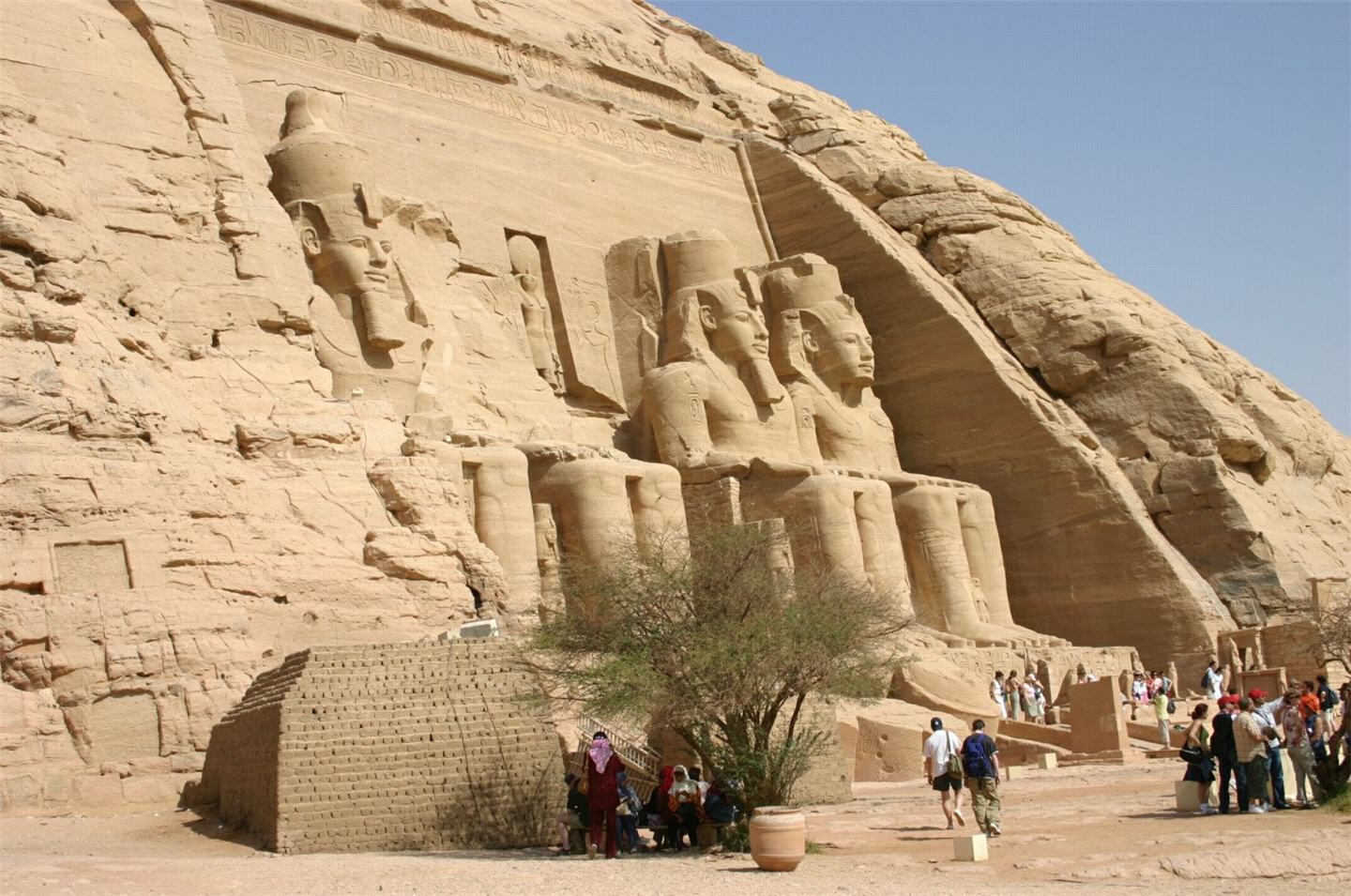
The Great Temple of Abu Simbel was completely carved out of the rock. Its facade, trapezoidal in form to mimic the pylon, is preceded by a terrace decorated with a series of  upright  statues  of  Horus  and Ramses II. The  facade is adorned with four colossal statues carved into the rock representing Ramses II seated and looking eastward. Around the king’s legs are statues of queens, princesses and princes. The facade is  dominated by a row of baboons greeting the rising sun. Above the entrance is a niche containing a statue of hawk-headed god Ra-Horakhty. The entrance leads to a large hall, the ceiling of which rests  on two  rows  of  four  Osirian  pillars. In  this  hall,  the  reliefs  are exceptionally  well  preserved. The eastern reliefs  represent two nerely symmetric scenes of the Pharaoh smiting his  enemies. On the northern wall, one can admire a detailed composition of the famous Battle of Qadesh, in which Ramses II  confronted  the  Hittites in the fifth year of his reign. As for the scenes of the southern wall, they show, from left to right, the king on his chariot attacking an Asian fortress, killing  a  Libyan enemy, and, finally, triumphant, atop his chariot. Off of the grand hall are a series of rooms called « treasure  rooms». Most likely, it was here that the most precious articles of the temple had been stored. The  back door of the hall leads to a room with four pillars. The north and south walls of this room are decorated with scenes of worship of the divine boats. It then leads to a rectangular vestibule containing three sanctuaries. In the middle one, four statues are carved into the rock representing, from left  to  right,  Ptah,  Amon-Ra, Ramses II and Ra-Horakhty. As Amelia Edwards, who visited the site in 1874, noticed for the first time, the three statues on the right are completely illuminated by rays of the sun from the entrance of the temple on October 21 and February 21 every year (Currntly on October 22 and February 22).

The small temple of Abu Simbel is located 150 m to the north of the Great Temple. Its facade, 12 meters high, is decorated  with six  colossi,  each  reaching  nerely 10 meters high: four represent Ramses II and two represent  his royal wife, Nefertari, to whom the temple  is  dedicated.  Statues of  the  royal  couple’s  children  are carved on both sides of their legs : the princes on the king’s side, and the princesses on the queen’s. The entrance leads to a hall with six Hathorian pillars. Its walls are  adorned with scenes of offerings and worship to the deities honored in the  temple. To the west of the hall are three doors  leading to a vestibule from which  the  sanctuary is  accessed.  The latter is decorated on the back wall with a sculpture of the cow goddess Hathor protecting Ramses II.

The temples of Abu Simbel were inscribed on the World Heritage List in 1979, and they enjoy  special  treatment  in terms of conservation and preservation.  You too can help us to protect these two prestigious historical monuments by respecting these guidelines.

Stages of the transfer of Abu Simbel Temples:

View  from  the Nile  of the Small Temple on its  original  site (old site) 


In November,  1964, a steel culvert through the sandfill in front  of the Great Temple waserected, to form an  access to the temple rooms


Dismant'ing  of the Hypostyle  Hall  (Great Temple)


The originial site after the process of cutting the temple' stones


-Using saws in the cutting process


Queen Nefertari as now temporarilyosened from her place at the leg of her royal consort


The statue of Ramses the Great


Pharaoh's knees being lifted after being cut loose


In February 1966 the dismantling of the temples was not far from completion


On arrival at the Storage Area, every block is carefully  lifted by a gantry crane and moved to its provisional place while  awaiting re-erection


Pharaoh regains his face


Behind the re-erected statues of King Ramesse the first arch element of the great dome above the temple rooms is under construction


Sky view of the Great Temple


The two Abu Simbel temples as they can now be seen from Lake Nasser on their new sites


When approaching the Great Temple, the visitor  feels almost overwhelmed by its beauty and grandeur


Temple of Abu Simbel

The oldest Nubian temples date back to the eighteenth dynasty (Buhen, al-Lessiya, Amada, etc.) while the most recent were erected during the Graeco-Roman period. However, of all the Egyptian Pharaohs, it was under Ramses II (thirteenth century BC) that Lower Nubia witnessed its most intensive period of temple construction. He erected seven temples therein : Beit al-Wali, Garf Hussein, Wadi al-Sebuâ, Derr (the only one on the east bank of the Nile), those of Abu Simbel and, finally, Akcha. The successors of this great ruler of the nineteenth dynasty would not build another temple in Nubia for nealy a millennium to come.

Sound and light of Abu Simbel


Temples of  Ramesses II and Nefertari


Map of the Great Temple of Ramses II:

1- Terrace.
2- Royal colossi of the Facade-Pylon.
3- Hall with Osirian pillars.
4- Second hall.
5- Northern and southern rooms of Tresor.
6- Vestibule.
7- Lateral rooms.
8- Sanctuary.


Plan of the great temple


Temple of Abu Simbel lies 270 km south of Aswan. In addition to the two cave-temples built by Ramses II, the walls of the surrounding hills feature twenty-eight stelae carved into the rock.

During his trip to Nubia, the Swiss traveller Johann Ludwig Burckhardt – also known as Sheikh Ibrahim ibn Abdallah – was the first Westerner to see « Ebsambal (=Abu Simbel) », on March  22, 1813. After visiting  the  small temple, he wandered a few tens of meters to the south, and discovered the upper part of the colossi of Ramses II of the Great Temple, still buried under the sand. Thereafter, the Italian Giovanni Battista Belzoni and his team managed to enter  the  Great  Temple of  Abu  Simbel  on  Friday, August  1st,  1817,  more than three millennia after its construction.

Temple of Abu Simbel

Great temple of Abu Simbel


Part of Abu Simbel temple

Interior of abu simbel

Baboon carvings above the heads of the statues of Ramses

Nefertari with Hathor

 Ramses attacke a Syrian fortress (Abu Simbel)

 Enemies being beaten by the Egyptians (Abu Simbel)


After the construction of the old Aswan Dam (1898-1902) and its subsequent two elevations (1907-1912 and 1929-1934), the water level to the south of Aswan had risen considerably and the temples of Philae had been inundated. The construction of the High Dam (1960-1971), and the huge Lake Nasser which would develop behind it – with an average width of over 10 km, length of 500 km and a total area greater than 6000 km² –  would  result  in  the complete  submersion of  the  monuments  of Nubia  (in  both  Egypt and  Sudan).  It was therefore necessary to act quickly to save these temples before they ultimately dissapeared under the water (that is to say, before 1968 for the site of Abu Simbel). The  Egyptian  authorities  and  international  community reacted  quickly  :  on  March  8,  1960,  the  General  Director of UNESCO issued a solemn appeal, thus inaugurating the International Campaign to Save the Monuments of Nubia. It would span twenty years.
Visitors of Abu Simbel

Pharaoh Meaning


The  kings  of  Egypt  were  not  originally  called  pharaohs  by  the  ancient Egyptians. In the late First Dynasty, the term used was nesu-bit, referring to the king, with the additional idea that the king was a combination of divine and mortal.

The term "pharaoh" for the king of Egypt developed over time, and was also used by the Hebrews and Greeks to describe the Egyptian ruler. Today, we commonly use the term "pharaoh" with reference to the kings of Ancient  Egypt,  including  the  Hyksos  and  Ptolemaic  rulers,  but  usually  not the Persian rulers, although many of them did have a formal Egyptian title manufactured for themselves.

In Ancient Egypt, the term "pharaoh" was not originally a royal title. Translated  literally,  the  earliest  meaning  of  the  Egyptian  word  per-o  was  "great house", that is the palace or residence of the king and his administration. This usage is found as early as 2500 BCE. The term "pharaoh" referred to the ordinances and commands the king issued in his administration, but not to the person of the king himself. In New Kingdom times (sixteenth century BCE), it  began  to  designate  the  king  himself,  rather  like  our  use  of  "The  White House"  to  refer  to  the  American  president  or  "The  Crown"  to  refer  to  the British  monarch.

Thus, at the beginning of the New Kingdom (Eighteenth Dynasty), we find Thutmose III (c. 1504-1450 BCE) referred to as "pharaoh." This is understood to be the earliest instance of the title being transferred to the king himself, and any reference before this period is considered an anachronism.

Note:

The number of hieroglyphic signs gradually grew to over 7000 in total, though not all of them were used on a regular basis (as with many of the words in an English dictionary).  The hieroglyphs were chosen from a wide variety of observed images, for example, people, birds, trees, or buildings.  Some signs represent the sounds of the ancient Egyptian language, but indicate consonants only. No vowels were written out.  Also, it was not an alphabetic system, since one sign could represent a combination of two or more consonants like the gaming-board hieroglyph which stands for the consonants "mn". Egyptologists make the sounds pronounceable by putting an "e" between the consonants, so "mn" is read as men. A vast number of other hieroglyphic signs were not pronounced at all but served to clarify meanings, such as a boat following the sound sign "dpt" which was the word for boat.

Labels